Bookkeeping for sole traders means keeping an accurate record of the money coming into and going out of your business.
For a self-employed person, those records are what eventually support the income, expenses and profit reported to HMRC. They can also help you understand whether the business is actually making money, what tax may be coming up and whether you are approaching VAT or Making Tax Digital thresholds.
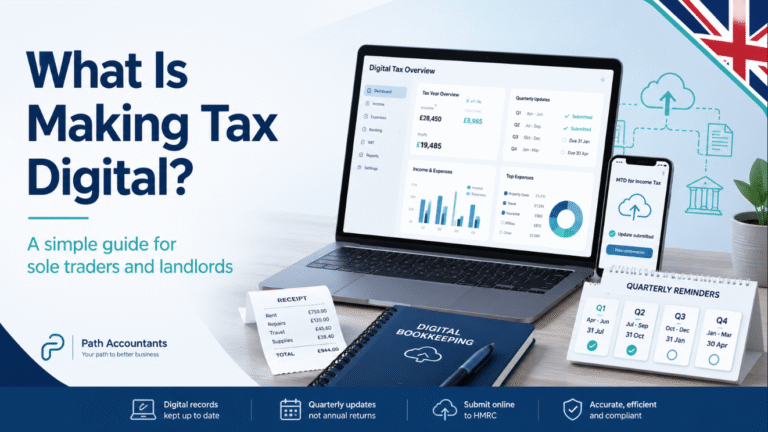
The rules have become more important in 2026/27 because Making Tax Digital for Income Tax is now mandatory for some sole traders.
This guide explains what records a sole trader should keep, how to organise bookkeeping, cash basis versus traditional accounting, allowable expenses, VAT, bookkeeping software and the new MTD for Income Tax requirements.
Sole Trader Bookkeeping at a Glance
| Question | Quick answer |
|---|---|
| Do sole traders need bookkeeping records? | Yes. You need records that support the figures included in your Self Assessment tax return. |
| How long should records be kept? | Normally at least 5 years after the 31 January submission deadline for the relevant tax year. |
| Do you need a business bank account? | Not necessarily, although separating business and personal transactions can make bookkeeping much easier. Check what your bank allows. |
| Is bookkeeping software compulsory? | Not for every sole trader. However, compatible software is required where Making Tax Digital for Income Tax applies, and separate digital-record rules apply to most VAT-registered businesses. |
| When does MTD for Income Tax apply? | From April 2026 for qualifying income over £50,000, with lower thresholds being introduced in 2027 and 2028. |
| Is cash basis still available? | Yes. Cash basis has been the default accounting method for most eligible self-employed businesses since the 2024/25 tax year. |
What Is Bookkeeping for a Sole Trader?
Sole trader bookkeeping is the process of recording and organising the financial transactions connected with your self-employed business.
That normally includes:
- Sales and other business income
- Business expenses
- Customer invoices
- Supplier bills
- Receipts
- Bank transactions
- Cash transactions
- Business mileage where relevant
- VAT records if you are VAT registered
- PAYE records if you employ people
You do not normally send all of these records to HMRC with your tax return.
Instead, you keep them so you can calculate your business profit or loss accurately and show how you arrived at the figures reported if HMRC asks for supporting records.
Bookkeeping also provides the starting point for wider small business accounting, tax preparation and financial reporting.
Why Bookkeeping Matters for Sole Traders
It is easy to think of bookkeeping as something that only matters when your Self Assessment deadline approaches.
In practice, leaving everything until January can create much bigger problems.
Receipts disappear, business and personal spending becomes difficult to separate, expenses are forgotten and it becomes harder to remember what individual transactions were for.
Keeping the books up to date can help you:
- Calculate business profit more accurately
- Identify allowable business costs
- Prepare for Self Assessment
- Keep evidence supporting expenses
- Monitor unpaid invoices
- Understand your cash position
- Track turnover against the VAT threshold
- Check whether Making Tax Digital may apply
- Give your accountant cleaner information at year end
It also gives you more useful information during the year instead of discovering how the business performed months after the year has finished.
What Bookkeeping Records Must a Sole Trader Keep?
HMRC requires self-employed people to keep records of business income and expenses for Self Assessment.
Typical records include:
Sales and business income
Keep evidence of the money the business earns, including:
- Sales invoices
- Customer payments
- Bank transfers
- Card payments
- Online payment-platform income
- Cash sales
- Other business receipts
Your bookkeeping should make it possible to trace the income recorded back to the underlying transaction.
Business expenses
Keep records of costs you believe relate to running the business.
Depending on the business, these might include:
- Office costs
- Software and subscriptions
- Advertising and marketing
- Professional fees
- Business travel
- Telephone costs
- Insurance
- Stock or materials
- Equipment
- Relevant premises costs
Not every cost paid from a business account automatically qualifies as an allowable tax expense.
Where a cost has both personal and business use, only the appropriate business element may be relevant.
Receipts and supporting evidence
Keep the documents supporting the transactions recorded in your books.
Examples include:
- Receipts
- Supplier invoices
- Bank statements
- Sales invoices
- Payment confirmations
- Mileage records
- Relevant contracts or agreements
HMRC’s record-keeping guidance for self-employed businesses explains the core records that should be retained.
How Long Do Sole Traders Need to Keep Bookkeeping Records?
For Self Assessment, records normally need to be kept for at least 5 years after the 31 January submission deadline for the relevant tax year.
For example, if the filing deadline for a return is 31 January 2027, the supporting records would normally need to be retained until at least the end of January 2032.
Different rules can apply in particular circumstances, including very late returns.
Digital storage can make this considerably easier. Receipts and invoices can be attached to individual bookkeeping transactions rather than stored in boxes that have to be searched through years later.
How to Do Bookkeeping as a Sole Trader
A simple sole trader bookkeeping system does not need dozens of spreadsheets or complicated accounting processes.
The important part is consistency.
1. Separate Business and Personal Transactions
A sole trader is not legally separate from their business in the same way as a limited company.
That does not mean mixing every personal and business transaction together is a good bookkeeping system.
Using a dedicated account for business transactions can make it easier to:
- Identify business income
- Find business expenses
- Reconcile transactions
- Review cash flow
- Prepare accounts
- Provide records to an accountant
A sole trader does not necessarily have to open a business bank account purely because they are self-employed, although you should check the terms of your bank account to make sure business use is permitted.
2. Record All Business Income
Your bookkeeping should capture all business income, not only the payments that are easiest to see in your main bank account.
That could include:
- Bank transfers
- Card payments
- Cash
- PayPal or similar services
- Marketplace payments
- Deposits
- Other business receipts
The date on which income is recorded for tax purposes can depend on the accounting method you use.
For most eligible sole traders using cash basis, income is generally recorded when the money is actually received.
Under traditional accounting, the timing can be different.
3. Record Business Expenses Properly
Do not wait until the tax return is being prepared to work out what individual payments were for.
Record the expense when it happens and give it a clear category.
For example:
£49.00 — accounting software subscription — software
is much more useful six months later than:
£49.00 — card payment
Keep the supporting receipt or invoice with the transaction wherever possible.
4. Keep Track of Business Mileage
If you use a vehicle for business journeys, maintain the information needed to support the business mileage being claimed.
A mileage record might contain:
- Date
- Business purpose
- Starting point
- Destination
- Business miles travelled
Sole traders may be able to use simplified expenses for qualifying vehicle mileage instead of calculating actual vehicle running costs.
The correct approach depends on the circumstances and how the vehicle has previously been treated.
5. Reconcile Your Bank Account
Bank reconciliation means comparing your bookkeeping records with the transactions shown on the bank account.
For example, your bookkeeping system may show £6,420 entering the business account during a month.
Your bank statement should help you establish whether all £6,420 has been recorded correctly and whether anything has been duplicated, omitted or allocated incorrectly.
Regular reconciliation can identify:
- Missing sales
- Duplicate transactions
- Missing expenses
- Bank charges
- Personal transactions
- Payments recorded against the wrong customer or supplier
For a straightforward sole trader, doing this monthly can make year-end bookkeeping considerably easier.
6. Review the Books Before Filing Anything
Do not assume that a bank feed automatically means the bookkeeping is correct.
Before using the numbers for Self Assessment, VAT or an MTD update, check that transactions have been:
- Included
- Categorised correctly
- Supported where necessary
- Reconciled
- Separated between business and personal use where applicable
Software can automate data entry. It cannot always determine the correct tax treatment without human review.
Cash Basis vs Traditional Accounting for Sole Traders
One important part of sole trader bookkeeping is deciding how income and expenses are recognised.
Cash basis
From the 2024/25 tax year, cash basis became the default accounting method for most eligible self-employed businesses unless they opt out or cannot use it.
Under cash basis, transactions are generally recorded for tax when money actually moves.
For example:
You send a customer an invoice for £1,200 on 25 March 2027.
They pay you on 15 April 2027.
If you are using cash basis, the £1,200 would normally fall into the tax year in which the payment was actually received.
Traditional accounting
Traditional accounting generally records income and expenses when they are earned or incurred rather than simply when money changes hands.
It can therefore require additional records covering areas such as:
- Outstanding customer invoices
- Supplier bills not yet paid
- Stock
- Work in progress
- Year-end balances
The appropriate method depends on the business and its circumstances.
A Simple Sole Trader Bookkeeping Example
Imagine a freelance designer using cash basis has the following during one month:
Business income received: £5,000
Business expenses paid:
- Software: £120
- Advertising: £300
- Professional fees: £180
- Business travel: £150
- Other allowable business costs: £450
Total recorded expenses: £1,200
That gives:
£5,000 income – £1,200 expenses = £3,800
So the bookkeeping currently shows £3,800 of profit before considering any other tax adjustments, allowances or items requiring year-end review.
Suppose the designer also issued another £800 invoice during the month but the customer has not yet paid it.
Under cash basis, that unpaid £800 would generally not yet be treated as received income.
Under traditional accounting, the timing would be different.
That is why knowing which accounting method you use matters.
Bookkeeping and Self Assessment
Your bookkeeping ultimately provides much of the information needed to calculate the self-employment figures reported through Self Assessment.
The records help establish:
- Business turnover
- Allowable business expenses
- Business profit or loss
- Relevant adjustments
That information then feeds into your HMRC Self Assessment.
If you have recently started working for yourself, make sure you also understand whether and when you need to register. See our guide to Self Assessment registration in the UK.
Depending on your circumstances, your Self Assessment return may also contain other income that is not part of the sole trader bookkeeping, such as employment, property, savings, dividends or capital gains.
Making Tax Digital for Income Tax and Sole Trader Bookkeeping
This is one of the biggest bookkeeping changes affecting sole traders in 2026.
Making Tax Digital for Income Tax is now live.
From 6 April 2026, qualifying sole traders and landlords with qualifying income of more than £50,000 are required to use Making Tax Digital for Income Tax unless an exemption or other exclusion applies.
The rollout then expands:
| Start date | Qualifying income threshold |
|---|---|
| 6 April 2026 | More than £50,000 |
| 6 April 2027 | More than £30,000 |
| 6 April 2028 | More than £20,000 |
Qualifying income is broadly the gross income before expenses from self-employment and property that HMRC uses to determine whether the MTD threshold has been exceeded.
It is not simply your taxable profit.
For sole traders within MTD for Income Tax, compatible software is required to:
- Create and store digital records
- Maintain records of relevant business income and expenses
- Send quarterly updates to HMRC
- Complete the required year-end tax-return process
What are the MTD quarterly deadlines?
For most taxpayers using the standard update periods, quarterly updates have deadlines of:
- 7 August
- 7 November
- 7 February
- 7 May
Quarterly updates are based on the digital income and expense records held in the software.
They do not replace the annual tax return.
The first MTD for Income Tax quarterly deadline was 7 August 2026.
For the 2026/27 tax year, HMRC has said that penalty points will not be issued for late quarterly updates, although taxpayers within MTD still need to send the required updates before completing their tax return and the normal rules for late returns and tax payments still matter.
If your income is approaching one of the future thresholds, setting up bookkeeping software before it becomes compulsory may make the transition easier.
Do Sole Traders Need Bookkeeping Software?
Not every sole trader is legally required to use bookkeeping software simply because they are self-employed.
However, the answer now depends on your circumstances.
If MTD for Income Tax applies to you
You need compatible software that can meet the Making Tax Digital requirements.
For 2026/27, this generally affects eligible sole traders and landlords with qualifying income over £50,000.
The threshold reduces in later years.
If you are VAT registered
Most VAT-registered businesses also have digital record-keeping and MTD requirements for VAT.
If neither applies
A simple business may still be able to maintain its records using a spreadsheet or another organised bookkeeping method.
However, software can make it easier to:
- Import bank transactions
- Attach receipts
- Raise invoices
- Track unpaid customers
- Reconcile accounts
- Categorise expenses
- Monitor turnover
- Share records with an accountant
The most important point is that your system must suit the rules that apply to your business.
VAT and Sole Trader Bookkeeping
VAT creates another layer of bookkeeping.
The current UK VAT registration threshold is generally £90,000 of taxable turnover measured over a rolling 12-month period, although VAT registration rules can depend on the circumstances.
If you are VAT registered, your records may need to distinguish between:
- Net sales
- Output VAT
- Purchases
- Input VAT
- Different VAT rates
- Exempt transactions where relevant
- Transactions outside the scope where relevant
Most VAT-registered businesses are also required to maintain digital VAT records and submit returns using MTD-compatible software unless an exemption applies.
This is separate from MTD for Income Tax.
A sole trader can therefore have different digital obligations depending on their VAT status and qualifying income.
A Practical Bookkeeping Routine for Sole Traders
Good bookkeeping usually comes from a repeatable routine rather than doing everything at the end of the year.
Every week
Consider:
- Uploading receipts
- Recording cash transactions
- Sending invoices
- Checking customer payments
- Recording business mileage
- Reviewing uncategorised transactions
Every month
Consider:
- Reconciling the bank
- Reviewing expenses
- Checking unpaid invoices
- Checking business versus personal transactions
- Reviewing profit
- Putting money aside for tax
Every quarter
Consider:
- Reviewing turnover
- Checking your VAT position
- Checking MTD thresholds
- Completing VAT returns if applicable
- Sending an MTD quarterly update if required
At year end
Complete a final review of:
- Income
- Expenses
- Bank reconciliation
- Supporting records
- Outstanding bookkeeping issues
- Tax adjustments requiring accountant review
This turns year-end accounting into a review of records that already exist rather than a reconstruction of an entire year’s activity.
Common Sole Trader Bookkeeping Mistakes
Some recurring bookkeeping problems include:
Mixing personal and business transactions
This makes reconciliation slower and increases the chance of personal spending being treated incorrectly.
Losing receipts
A transaction appearing on a bank statement does not always explain what was purchased or why it was for the business.
Missing cash income
Cash received by the business still needs to be recorded.
Recording the same transaction twice
This can happen when transactions are manually entered and then imported again through a bank feed.
Guessing expense figures
Where actual records should exist, estimating costs rather than maintaining evidence creates unnecessary uncertainty.
Ignoring mileage records until year end
Trying to reconstruct months of business journeys from memory can be difficult.
Assuming software is always correct
Automatic categorisation can be useful, but transactions still need to be reviewed.
Leaving bookkeeping until the Self Assessment deadline
A January rush gives you less time to find missing documents, resolve unclear transactions or correct errors.
These mistakes can make it harder to support the figures in your tax return if HMRC asks for your records.
DIY Bookkeeping vs Using a Bookkeeper
Some sole traders can manage their own bookkeeping successfully.
DIY bookkeeping may work well when:
- Transaction volume is low
- The business is straightforward
- Records are updated regularly
- You understand the accounting method being used
- VAT does not add significant complexity
- You are comfortable with the software
Professional bookkeeping becomes more useful as complexity increases.
You may want help if:
- Your bookkeeping is several months behind
- You are becoming VAT registered
- MTD for Income Tax applies
- You have several income streams
- You employ people
- Transaction volume is increasing
- You are unsure which costs are allowable
- You spend too much time fixing bookkeeping errors
- You want more regular financial reporting
Many businesses use a mixture: the owner raises invoices and uploads receipts while a bookkeeper manages reconciliations, corrections and regular reviews.
Bookkeeping for Sole Traders With Path Accountants
Path Accountants supports sole traders who want their bookkeeping organised throughout the year rather than reconstructed immediately before a tax deadline.
Support can include:
- Day-to-day bookkeeping
- Bank reconciliation
- Income and expense recording
- Bookkeeping clean-up
- Self Assessment support
- VAT bookkeeping where applicable
- Preparing for Making Tax Digital
- Ongoing accounting support
Regular bookkeeping can also provide a stronger foundation for tax preparation and wider bookkeeping services.
If your current records are behind, the first step is normally to establish what information exists, which periods need attention and which filing obligations apply.
Need help keeping your
books clear and up to date?
Book a free consultation with Path Accountants to discuss your bookkeeping, Self Assessment, VAT or Making Tax Digital requirements.
How Better Bookkeeping Helps You Run the Business
Bookkeeping is not only about submitting figures to HMRC.
Accurate records can help answer questions such as:
- How much am I actually earning?
- Which months are strongest?
- How much do I spend running the business?
- Which customers still owe me money?
- Am I approaching the VAT threshold?
- Could MTD for Income Tax apply next year?
- Can I afford new equipment?
- Do I have enough cash available for tax?
- Is the business becoming large enough to consider a different structure?
If your business is growing and you are considering incorporation, our sole trader vs limited company guide explains some of the differences.
Sole Trader Bookkeeping Checklist
Before you consider your bookkeeping up to date, check that you have:
- Recorded all business income
- Recorded all relevant expenses
- Included cash transactions
- Kept receipts and invoices
- Recorded business mileage where relevant
- Reconciled your bank transactions
- Separated personal transactions
- Checked unpaid customer invoices
- Reviewed VAT requirements
- Checked whether MTD for Income Tax applies
- Kept records supporting your Self Assessment figures
- Reviewed anything unusual before filing
Frequently Asked Questions About Bookkeeping for Sole Traders
Do sole traders legally need to keep bookkeeping records?
Yes. Sole traders need to keep records of business income and expenses so they can complete Self Assessment accurately and support the figures reported to HMRC if asked.
How long should a sole trader keep bookkeeping records?
Normally, Self Assessment records should be kept for at least five years after the 31 January submission deadline for the relevant tax year.
Do sole traders need bookkeeping software?
Not every sole trader does. However, digital record-keeping requirements now depend on whether Making Tax Digital applies to you.
From 6 April 2026, qualifying sole traders and landlords with qualifying income over £50,000 must use compatible software for MTD for Income Tax unless an exemption or exclusion applies. The threshold falls to more than £30,000 from April 2027 and more than £20,000 from April 2028.
Most VAT-registered businesses also have separate MTD requirements for VAT.
Can a sole trader use Excel or a spreadsheet for bookkeeping?
A spreadsheet may be sufficient for a simple sole trader outside mandatory digital-reporting requirements if it produces accurate and complete records.
If MTD for Income Tax or MTD for VAT applies, your bookkeeping setup must satisfy the relevant digital record and compatible-software requirements.
Do sole traders need a separate business bank account?
A sole trader is not automatically required to open a separate business bank account purely because they are self-employed.
However, separating business transactions from personal spending generally makes bookkeeping and bank reconciliation much easier. You should also check whether your bank permits business transactions through the account you use.
What is qualifying income for MTD for Income Tax?
Qualifying income is broadly your gross income from self-employment and property before expenses, rather than your taxable profit.
The tax return used to determine whether you cross the threshold depends on the MTD start year.
Is bookkeeping the same as accounting?
No.
Bookkeeping focuses on recording and organising financial transactions.
Accounting uses those records to prepare accounts, calculate tax, make adjustments, analyse performance and help with financial decisions.
How often should a sole trader update bookkeeping?
There is no universal rule saying every sole trader must perform bookkeeping weekly.
However, updating records regularly reduces the amount of information that has to be reconstructed later.
Weekly transaction processing and monthly reconciliation is a practical routine for many small businesses.
Sole traders within MTD for Income Tax also need to meet the applicable digital record and quarterly reporting requirements.
Can Path Accountants take over bookkeeping that is already behind?
Yes. The starting point is to identify the periods involved, review the records available and establish what needs to be corrected or completed before an ongoing process is put in place.
Need Help With Sole Trader Bookkeeping?
If your bookkeeping is behind, MTD for Income Tax now applies to you, or you simply want a clearer process before the next Self Assessment deadline, Path Accountants can review the current position and explain what support is appropriate.
Good bookkeeping should give you more than a tax-return figure.
It should give you reliable records throughout the year, make deadlines easier to manage and help you understand what is happening financially in the business.
Get expert help before your next tax deadline.
Path Accountants helps UK small businesses stay compliant, organised, and tax efficient.

Mohammad Hamza Pathan
ACA Chartered Accountant & Technical Reviewer
ICAEW verified practising certificateMohammad Hamza Pathan is an ICAEW Chartered Accountant and a director of Path Accountants. He reviews Path Accountants guides for technical accuracy, practical relevance and alignment with current UK accounting and tax requirements before publication or substantive updates.
Qualifications and experience
- ICAEW Chartered Accountant (ACA), admitted in 2020 and holder of an ICAEW practising certificate.
- Accountant at Path Accountants and a registered director of Path Accountants Ltd.
- Education listed as Cass Business School.
Professional review areas
- UK tax compliance
- Statutory and company accounts
- Self Assessment
- VAT and Making Tax Digital
- Bookkeeping and payroll
- Small-business accounting
Technical claims, UK terminology, key compliance points and whether the guidance clearly distinguishes general information from advice that depends on a reader's circumstances.