
Seeing another HMRC bill appear in July can be worrying, especially when you already paid a large amount in January. It often looks as though HMRC has charged the same tax twice.
Usually, it has not. The July amount is normally the second payment on account – an advance towards the tax bill for the year that has just ended. Because HMRC bases it mainly on an earlier year’s figures, the amount may be too high if your income has fallen.
Not sure whether your Self Assessment payment is right? Speak to Path Tax Accountants before paying or reducing it. A proper calculation can protect your cash flow without creating interest problems later.
What is a Self Assessment payment?
A Self Assessment payment is tax paid directly to HMRC when the full amount has not already been collected through PAYE or another deduction system. You may receive a bill because you earned money from self-employment, freelance work, rental property, dividends, savings, investments, foreign income or capital gains.
New taxpayers may need to complete Self Assessment registration first.
Your January bill can contain:
- A balancing payment for tax still owed for the previous tax year
- A first payment on account towards the following tax year
The second payment on account is normally due on 31 July.
What is the second payment on account from HMRC?
Under HMRC’s payment-on-account rules, the bill is usually split into two equal instalments. Each instalment is normally half the qualifying tax owed for the previous year.
For the 2025/26 tax year:
- The first instalment was due on 31 January 2026
- The second is due by midnight on 31 July 2026
- Any remaining balancing payment is normally due on 31 January 2027
The July Self Assessment payment is not an extra tax or service fee. It is money paid early towards the final liability.
Do I need to make a second payment on account?
You will normally need to make both instalments unless:
- Your relevant Self Assessment bill for the previous year was less than £1,000
- More than 80% of your total tax was collected outside Self Assessment, such as through PAYE
Your HMRC statement or online account should confirm whether an instalment is due. You can also read our guide to HMRC Self Assessment and check the main tax return deadlines.
Check the charge type, tax year and deadline in your online account.
Why do I have to pay tax in July in the UK?
Payments on account help HMRC collect tax closer to the period in which the income is earned. For sole traders, landlords and freelancers, they spread the expected bill between January and July.
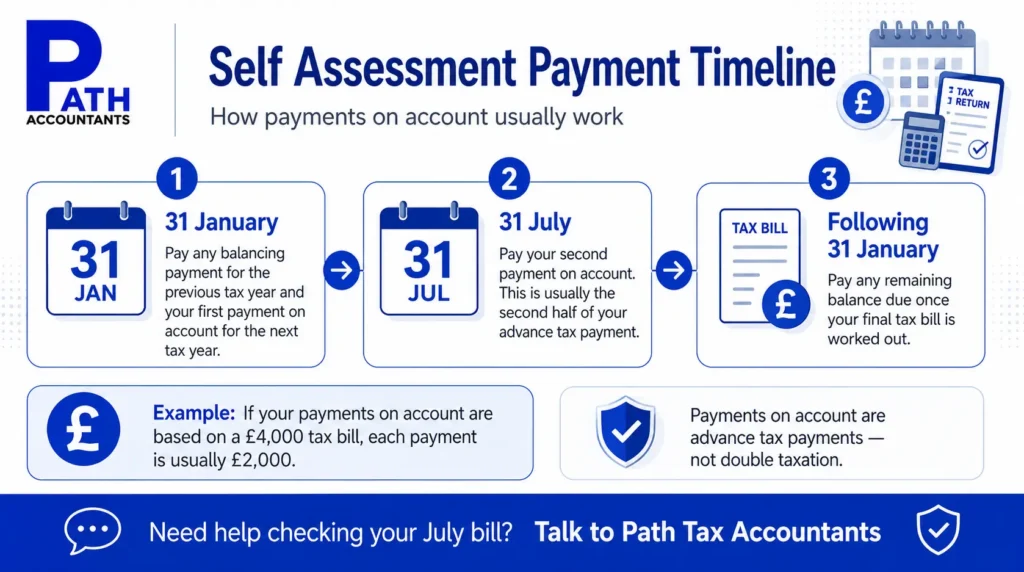
Suppose your relevant 2024/25 bill was £4,000. Your payments could be:
- £4,000 balancing payment by 31 January 2026
- £2,000 first payment on account on the same date
- £2,000 second payment on account by 31 July 2026
The January total would be £6,000, but £2,000 is an advance for 2025/26 rather than a second charge on the old income.
Good records make these amounts easier to predict. See our guides to bookkeeping for sole traders and allowable self-employed expenses.
Can I reduce my Self Assessment payment if my income dropped?
Yes. If you reasonably expect your liability to be lower than last year, you can ask HMRC to reduce the payments on account.
A reduction may be suitable if:
- Your turnover or profit has fallen
- You stopped trading or worked for only part of the year
- A rental property was empty or sold
- More tax was deducted through PAYE or CIS
- Your expenses or available tax relief increased
You can apply online or use form SA303. You must give a reason and enter a realistic revised estimate.
Being unable to afford the bill is not, by itself, a valid reason. Your expected tax liability must genuinely be lower.
How can I lower my 31 July tax payment online?
First estimate your full-year income, allowable costs, tax deductions and reliefs. Do not base the decision only on the balance in your bank account.
To reduce the amount online:
- Sign in to your HMRC online account.
- Open your latest Self Assessment return.
- Select “Reduce payments on account”.
- Enter the revised estimate and explain the change.
- Save the confirmation and check your updated statement.
You could also file the 2025/26 return before 31 July 2026. An early return gives HMRC the actual year-end figures and can confirm whether the July instalment should be reduced, increased or cleared.
Keeping records in suitable sole-trader accounting software makes this calculation much easier.
What happens if I reduce the payment too much?
If your final bill is higher than the reduced estimate, HMRC charges interest on the shortfall from the original payment dates.
HMRC may also charge a penalty where a reduction claim was made fraudulently or negligently. An honest estimate made in good faith is different, but you should still keep evidence supporting your figures.
Keep current accounts, reduced contracts, rental statements and PAYE or CIS records to support the estimate. If your income improves, revise the claim upwards and pay the difference promptly.
How do I pay HMRC’s second payment on account?
You can make a Self Assessment payment through the official HMRC payment service. Payment methods include:
- Online banking or Faster Payments
- CHAPS or Bacs
- Direct Debit
- Personal debit card
- Corporate debit or corporate credit card
- Cheque
- The HMRC app
Allow enough processing time, especially when setting up a new Direct Debit.
Can I pay the July tax bill by credit card?
HMRC does not accept personal credit cards for Self Assessment. Corporate credit and debit cards are accepted, but a non-refundable fee applies. Personal debit-card payments do not carry that HMRC fee.
Check the current HMRC card-payment guidance before paying.
What HMRC payment reference should I use?
Your reference is normally your 10-digit Unique Taxpayer Reference followed by the letter K, creating an 11-character code — for example, 1234567890K.
Using the wrong reference can delay allocation and leave the account showing unpaid. Confirm it in your online account and follow HMRC’s bank-transfer instructions.
What if I cannot afford the July Self Assessment payment?
Do not reduce the figure simply because cash is tight. A reduction changes the expected tax liability; it is not a payment plan.
Instead:
- Pay as much as you reasonably can before the deadline
- Contact HMRC as early as possible
- Check whether a Time to Pay arrangement is available
- Submit any outstanding return
- Prepare details of income, essential spending, savings and other debts
Eligible taxpayers owing up to £30,000 may be able to arrange an HMRC Time to Pay plan online. Those owing more or needing longer may still be able to apply by contacting HMRC directly.
Interest usually continues on the unpaid amount, even where a plan is agreed.
Is there a penalty for missing the 31 July deadline?
Late-payment interest starts on an unpaid payment on account from the due date.
However, HMRC’s current late-payment manual explains that the normal 5% Self Assessment late-payment penalties are not immediately charged against a payment on account by itself. If it remains unpaid, it becomes part of the balancing amount at the following 31 January and may then be included in later penalty calculations.
That does not make the July deadline safe to ignore. Interest continues, the debt remains due and the unpaid amount can eventually attract penalties.
Is your July bill too high? Let Path Tax Accountants check it
The hardest part is not making the transfer. It is deciding whether the figure is correct.
At Path Tax Accountants, we can review your records, estimate the real liability and explain whether you should pay the full amount, submit an SA303 reduction or file the return early.
We help sole traders, landlords, contractors and small businesses with calculations, payment-on-account reviews, expense checks, bookkeeping, tax planning and HMRC correspondence.
Our Self Assessment tax return accountants in London can turn a rough estimate into a properly supported calculation.
Unsure what you need to pay by 31 July? Book a free consultation before making or reducing the payment.
Final check before paying
Before making your Self Assessment payment, confirm the tax year, charge type, amount, deadline and payment reference. Then decide whether paying, reducing the instalment or requesting Time to Pay is appropriate. A careful check can prevent overpayment and avoidable interest.
FAQs
Is the second payment on account optional?
No. If it appears as due on your statement, it remains payable unless an accepted reduction or completed tax return changes it.
Can I cancel the second payment on account?
You can reduce it to nil only when a reasonable calculation shows that no payment on account will be needed.
Does filing early mean paying early?
No. It confirms what you owe without normally bringing the payment deadline forward.
Get expert help before your next tax deadline.
Path Accountants helps UK small businesses stay compliant, organised, and tax efficient.

Mohammad Hamza Pathan
ACA Chartered Accountant & Technical Reviewer
ICAEW verified practising certificateMohammad Hamza Pathan is an ICAEW Chartered Accountant and a director of Path Accountants. He reviews Path Accountants guides for technical accuracy, practical relevance and alignment with current UK accounting and tax requirements before publication or substantive updates.
Qualifications and experience
- ICAEW Chartered Accountant (ACA), admitted in 2020 and holder of an ICAEW practising certificate.
- Accountant at Path Accountants and a registered director of Path Accountants Ltd.
- Education listed as Cass Business School.
Professional review areas
- UK tax compliance
- Statutory and company accounts
- Self Assessment
- VAT and Making Tax Digital
- Bookkeeping and payroll
- Small-business accounting
Technical claims, UK terminology, key compliance points and whether the guidance clearly distinguishes general information from advice that depends on a reader's circumstances.
