Running a small business already keeps your head full. You deal with customers, invoices, payments, suppliers, staff, marketing, and then accounts sit there waiting for you at the end of the day.
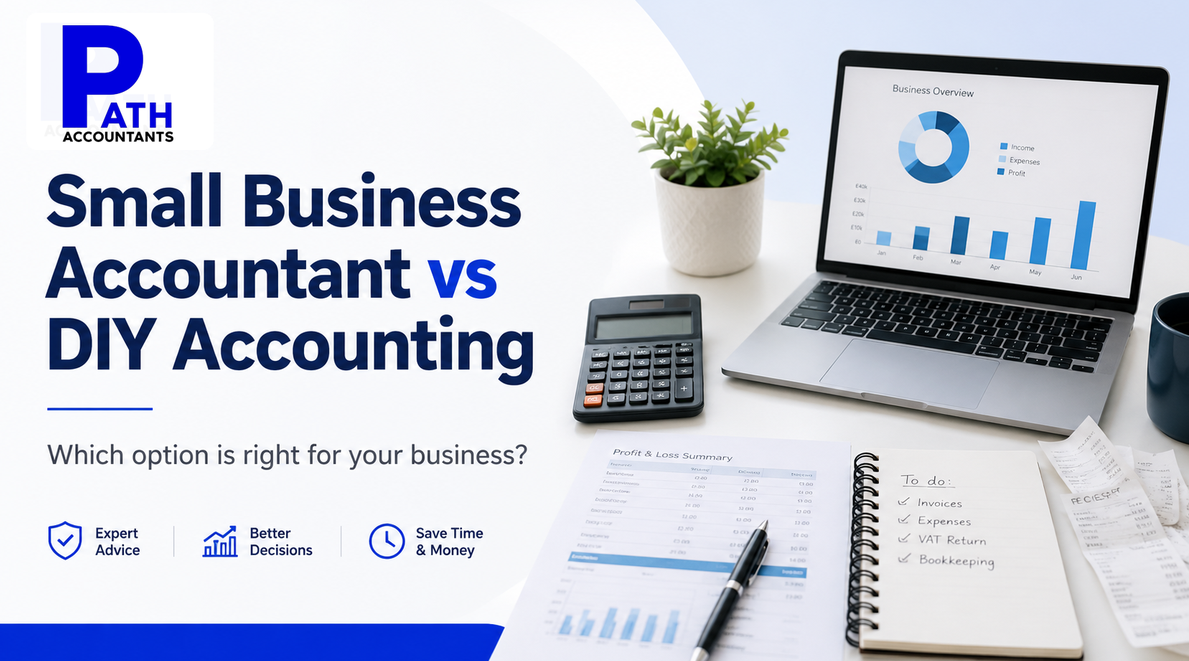
The answer depends on your business size, your confidence with numbers, and how much time you can give to bookkeeping. This guide explains Small Business Accountant vs DIY Accounting in simple terms, so you can decide what makes sense for your business.
Small Business Accountant vs DIY Accounting comes down to risk, time, and business growth. DIY accounting can work if your business is simple, you have few transactions, and you feel confident using accounting software. A small business accountant is usually better if you deal with VAT, payroll, Self Assessment, Corporation Tax, staff wages, company accounts, or business growth planning.
For a deeper guide, you can also read our page on small business accounting.
What DIY accounting means?
DIY accounting means you handle your own records, bookkeeping, tax figures, receipts, invoices, and deadlines. Some business owners use spreadsheets. Others use software like Xero, QuickBooks, FreeAgent, or Sage. If you are a sole trader, our guide on the best accounting software for sole traders may help.
DIY accounting usually includes:
- Recording sales and income correctly
- Keeping receipts for business costs
- Checking which expenses you can claim
- Matching bank transactions with invoices
- Preparing figures for tax returns
- Watching important HMRC deadlines
- Keeping records in case HMRC asks for them
HMRC says self employed people must keep records of business income and expenses for their Self Assessment return. You can read the official guidance on GOV.UK business records.
When DIY accounting can work well
DIY is not always a bad choice. In the early stage, it can help you understand how money moves in and out of your business.
It may work well if:
- You are a sole trader with simple income and expenses
- You have no staff and no payroll to manage
- You are not VAT registered
- You update your records every week
- You understand basic tax deadlines
- You feel comfortable using accounting software
- Your business bank account is separate from personal spending
If you are self employed, you may also find this useful, what expenses can I claim as self employed.
Where DIY accounting starts to become risky
The problem with DIY accounting is not always the work itself. It is the things you do not know you have missed. Small mistakes can build up quietly. By the time you notice them, the tax deadline may be close and the records may be messy.
Common DIY problems include:
- Mixing personal and business spending
- Forgetting cash payments or small expenses
- Claiming costs that are not allowable
- Missing expenses that could reduce your tax bill
- Recording VAT incorrectly
- Not understanding profit properly
- Leaving bookkeeping until the last minute
- Missing HMRC letters or deadlines
If VAT is involved, mistakes can get expensive. You can read our guide on common VAT mistakes small businesses make.
What a small business accountant actually does
A good accountant does more than submit a tax return once a year. They help you keep the numbers clean, understand your tax position, and make better business decisions. This is where Small Business Accountant vs DIY Accounting becomes more than a cost comparison.
A small business accountant can help with:
- Bookkeeping and regular record checks
- Self Assessment tax returns
- Limited company accounts
- Corporation Tax
- VAT returns and VAT registration
- Payroll and payslips
- Director salary and dividends
- Business expense reviews
- Cash flow planning
- HMRC letters and deadline support
If bookkeeping is already taking too much time, our small business bookkeeping guide is a good place to start.
VAT makes the decision more serious
VAT is one of the main reasons business owners move from DIY to accountant support. You must usually register for VAT if your taxable turnover goes over £90,000 in a 12 month period. You can check the official rule on GOV.UK VAT registration.
Once VAT applies, you need to think about:
- Correct VAT rates
- VAT invoices
- Digital VAT records
- VAT return deadlines
- Input VAT on purchases
- Output VAT on sales
- Whether a scheme suits your business
You may also want to read our guides on VAT threshold and the VAT Flat Rate Scheme.
Making Tax Digital is changing the way records are kept
Making Tax Digital is another reason Small Business Accountant vs DIY Accounting matters more now. From 6 April 2026, many sole traders and landlords with qualifying income over £50,000 need to use Making Tax Digital for Income Tax. The threshold then reduces in later years. You can check the official rules on GOV.UK Making Tax Digital.
This means affected businesses may need to:
- Keep digital records
- Use compatible software
- Send updates to HMRC
- Stay more organised during the year
- Avoid leaving everything until January
For a simple breakdown, read our guide on what is Making Tax Digital.
Cost comparison, accountant fee vs your own time
DIY accounting looks cheaper at first. You may only pay for software, or nothing if you use a spreadsheet. But your time is not free.
Ask yourself:
- How many hours do you spend sorting accounts each month?
- Could that time bring in more sales?
- Are you confident your figures are right?
- Do you know what tax you may owe?
- Would your records make sense if HMRC checked them?
- Are you missing tax saving opportunities?
This is the real Small Business Accountant vs DIY Accounting decision. It is not only about paying less. It is about whether your current setup helps or slows down your business.
Sole trader or limited company, the choice matters
DIY is easier for a simple sole trader than for a limited company. A limited company has more rules, more reporting, and more planning decisions. You may need support with Corporation Tax, Companies House accounts, dividends, director salary, and business expenses.
If you are unsure about your structure, read our guide on sole trader vs limited company. This is often the point where an accountant becomes more useful. You are no longer only tracking money. You are making decisions that affect tax, pay, cash flow, and future growth.
How Path Accountants helps small businesses
At Path Accountants, we know most business owners are not trying to avoid their accounts. They are just busy. You may be running jobs, handling calls, chasing invoices, paying suppliers, and trying to grow the business. Accounts can easily become the task you leave for Sunday night.
Path Accountants helps UK small businesses with:
- Bookkeeping
- VAT returns
- Payroll
- Self Assessment
- Limited company accounts
- Corporation Tax
- Tax planning
- Business advice
If you are still stuck between Small Business Accountant vs DIY Accounting, we can help you choose the right level of support. You may not need to hand over everything straight away. Sometimes you only need a clean setup, a review, or monthly support.
You can speak to our team through our free consultation page or visit accountants for small businesses London if you want local support.
Conclusion
Choose DIY accounting if your business is simple, your records are tidy, and you feel confident with tax basics. Choose an accountant if your accounts take too much time, your tax feels unclear, you are close to VAT registration, you run a limited company, or you want advice before making bigger business decisions.
Small Business Accountant vs DIY Accounting is not about which option sounds cheaper today. It is about which option gives you better control, fewer mistakes, and more peace of mind.
FAQs
Is DIY accounting enough for a small business?
DIY accounting can be enough if your business is simple, your records are tidy, and you are confident with tax basics. It works best for sole traders with few transactions, no VAT, no payroll, and no complex business costs.
When should I hire a small business accountant?
You should hire a small business accountant when your accounts start taking too much time, your tax feels unclear, or your business becomes more complex. This often happens when you register for VAT, run payroll, become a limited company, or need help with tax planning.
Is an accountant worth it for a small business in the UK?
Yes, an accountant can be worth it if they save you time, reduce mistakes, help you claim the right expenses, and keep you ready for HMRC deadlines. The value is not only in filing tax returns. It is also in getting clear advice before problems appear.
Can I do my own bookkeeping and still use an accountant?
Yes, many small business owners do basic bookkeeping themselves and use an accountant for reviews, tax returns, VAT, payroll, and advice. This can be a good middle option if you want to keep costs controlled but still want professional support.
Do I need an accountant if I use accounting software?
Accounting software helps with records, invoices, and reports, but it does not replace proper advice. You still need to understand what to record, what you can claim, how VAT works, and whether your tax figures are correct.
Is an accountant better for a limited company?
In most cases, yes. Limited companies have more rules around annual accounts, Corporation Tax, director salary, dividends, payroll, and Companies House filings. An accountant can help keep everything correct and avoid costly mistakes.
What is the best choice for growing small businesses?
For growing businesses, an accountant is usually the safer choice. Growth brings more sales, more costs, more tax decisions, and more admin. Professional support can help you stay organised and make better decisions with your numbers.
Get expert help before your next tax deadline.
Path Accountants helps UK small businesses stay compliant, organised, and tax efficient.

Mohammad Hamza Pathan
ACA Chartered Accountant & Technical Reviewer
ICAEW verified practising certificateMohammad Hamza Pathan is an ICAEW Chartered Accountant and a director of Path Accountants. He reviews Path Accountants guides for technical accuracy, practical relevance and alignment with current UK accounting and tax requirements before publication or substantive updates.
Qualifications and experience
- ICAEW Chartered Accountant (ACA), admitted in 2020 and holder of an ICAEW practising certificate.
- Accountant at Path Accountants and a registered director of Path Accountants Ltd.
- Education listed as Cass Business School.
Professional review areas
- UK tax compliance
- Statutory and company accounts
- Self Assessment
- VAT and Making Tax Digital
- Bookkeeping and payroll
- Small-business accounting
Technical claims, UK terminology, key compliance points and whether the guidance clearly distinguishes general information from advice that depends on a reader's circumstances.