The VAT threshold marks an important point for UK businesses. Once your taxable turnover exceeds a certain level, you must register for VAT and follow HMRC reporting rules.
Many businesses only realise the impact after they cross the threshold. VAT registration changes how you price services, manage cash flow, issue invoices, and handle reporting. Without early planning, it can create unexpected costs and financial pressure.
In this guide, we explain how the VAT threshold works, when you must register, and how to stay compliant while protecting profitability.
What Is the VAT Threshold?
In 2026, the VAT threshold is £90,000 in taxable turnover over a rolling 12-month period. Once you exceed this limit, you must register for VAT with HMRC.
The threshold has remained stable in recent years:
- VAT threshold in 2026: £90,000
- VAT threshold in 2025: £90,000
- VAT threshold in 2024: £90,000
After registration, you must:
- Charge VAT on eligible goods and services
- Submit VAT returns, usually every quarter
- Keep digital records under Making Tax Digital (MTD)
- Use HMRC-approved accounting software
For example, if a small marketing agency grows from £70,000 to £95,000 in annual taxable turnover, it must register for VAT once it crosses the threshold.
VAT registration affects pricing, invoicing, reporting, and cash flow, and often becomes a key milestone for growing businesses.
How the UK VAT Threshold Rules Work
HMRC does not assess VAT based on fixed tax years. Instead, it monitors your turnover continuously over time.
You must register for VAT if your taxable turnover goes over £90,000 within any 12-month period. Each month, you must check your sales from the previous year to see if you have crossed the limit.
HMRC also uses a forward-looking rule. If you expect your turnover to exceed £90,000 in the next 30 days, you must register immediately, even if you have not yet received the income.
For example, if a contractor signs a £100,000 project starting next month, HMRC may require VAT registration straight away.
Once you cross the threshold, you must notify HMRC within the legal timeframe and complete registration without delay.
How Is the VAT Threshold Calculated?
You calculate the VAT threshold by adding up your taxable turnover from the past 12 months. This includes all sales of goods or services before VAT is added.
Your taxable turnover includes:
| Type of sale | VAT rate | Counts toward threshold? |
| Standard-rated sales | 20% | Yes |
| Reduced-rated sales | 5% | Yes |
| Zero-rated sales | 0% | Yes |
| VAT-exempt income | N/A | No |
VAT rates help identify what is taxable, but the threshold depends only on total taxable turnover.
For example, if you make £60,000 in standard-rated sales and £30,000 in zero-rated sales, your taxable turnover is £90,000. At that point, you must register for VAT.
If you run an online or international business, place-of-supply rules can also apply, and some overseas sales can still count depending on how and where you provide your services or goods.
VAT Registration Risks & Compliance Issues
Once you become liable for VAT, HMRC expects full compliance.
Businesses must:
- Notify HMRC within 30 days of becoming liable
- Register correctly (HMRC can backdate if missed)
- Submit VAT returns quarterly and comply with Making Tax Digital
- Keep accurate records. HMRC may backdate VAT, apply penalties and interest, and investigate businesses with warning signs such as rapid turnover growth, inconsistent VAT treatment, or poor bookkeeping.
Failure to register on time can lead to significant financial consequences.
For example, if a business crosses the threshold in March but waits until July to register, HMRC may still charge VAT from the original registration date along with penalties and interest.
VAT Strategy for Growing Businesses
VAT should form part of your financial planning, not just compliance.
Many businesses near the threshold choose voluntary VAT registration. This allows them to:
- Reclaim VAT on business expenses
- Work more easily with VAT-registered clients
- Prepare early for business growth and scaling
VAT also affects pricing and cash flow. Businesses must decide whether to absorb the VAT cost or pass it on to customers, which can affect competitiveness.
For example, a consultant working mainly with VAT-registered corporate clients may benefit from voluntary registration because clients can reclaim the VAT charged.
Strong VAT planning comes from regular turnover tracking, realistic forecasting, and early preparation before reaching the threshold.
When can you deregister from VAT?
You can deregister from VAT if your taxable turnover falls below £88,000 or if you expect it to stay below this level over the next 12 months. You can also deregister if you stop trading or no longer make VAT-taxable sales.
You must notify HMRC within 30 days of becoming eligible. VAT still applies until HMRC confirms deregistration, and you must submit a final VAT return.
You must cancel your VAT registration if:
- You stop trading or no longer make taxable sales
- You sell or transfer your business and do not keep the VAT number
- You join a VAT group
- You change business structure and need a new VAT registration
For example, if a sole trader converts into a limited company, the business may need a new VAT registration depending on the structure change.
What Counts Towards the VAT Threshold?
The VAT threshold is based on your VAT-taxable turnover, not your total income. This means you add up all sales that would have VAT applied if you were registered whether they’re standard-rated at 20%, reduced-rated at 5%, or zero-rated at 0%. For example, if you sell £60,000 worth of standard-rated goods, £20,000 of reduced-rated items, and £10,000 of zero-rated products in a 12-month period, your taxable turnover would be £90,000, hitting the threshold. It doesn’t include VAT-exempt sales, such as most financial services, insurance, or certain types of education.
Voluntary Registration Below the Threshold
You don’t need to wait until your turnover reaches the £90,000 VAT threshold to register. Many small businesses choose to do it early mainly to claim VAT back on purchases, look more professional to clients, and avoid sudden changes when they pass the limit.
| Type of Business | Annual Turnover | Typical Annual Costs (excl. VAT) | Why Early Registration Helps |
| Freelance graphic designer | £35,000 | £8,000 equipment & software | Can get back VAT on big costs up front |
| Retail shop | £60,000 | £25,000 stock purchases | Large savings on VAT for stock |
| Consultancy firm | £50,000 | £5,000 travel & office expenses | A professional look for business clients |
Of course, registering means more work for the government, like filing quarterly VAT returns, keeping records, and changing prices to include VAT. So it’s a good idea to think about the pros and cons before making a decision.
The Current VAT Threshold and Past Changes
For years VAT threshold stayed at £85,000, until April 2024 when it went up to £90,000 around a 6% rise. In 2025, it’s still £90,000, but that could change in the future depending on things like inflation, government budgets, or even international agreements such as the Northern Ireland Protocol. It’s a good idea to check the number each tax year so you don’t get caught out.
Common Mistakes Businesses Make
Some business owners only check their turnover once a year, and by then they may have been over the VAT threshold for months, owing backdated VAT to HMRC. Others track the wrong figures, focusing on profit instead of VAT-taxable turnover, which includes UK sales even if they’re made online from abroad. Seasonal peaks can also catch people out a busy Christmas period, a sudden growth spurt, or one big order can easily push turnover past the limit without them realising.
Strategies to Stay on Top of the VAT Threshold
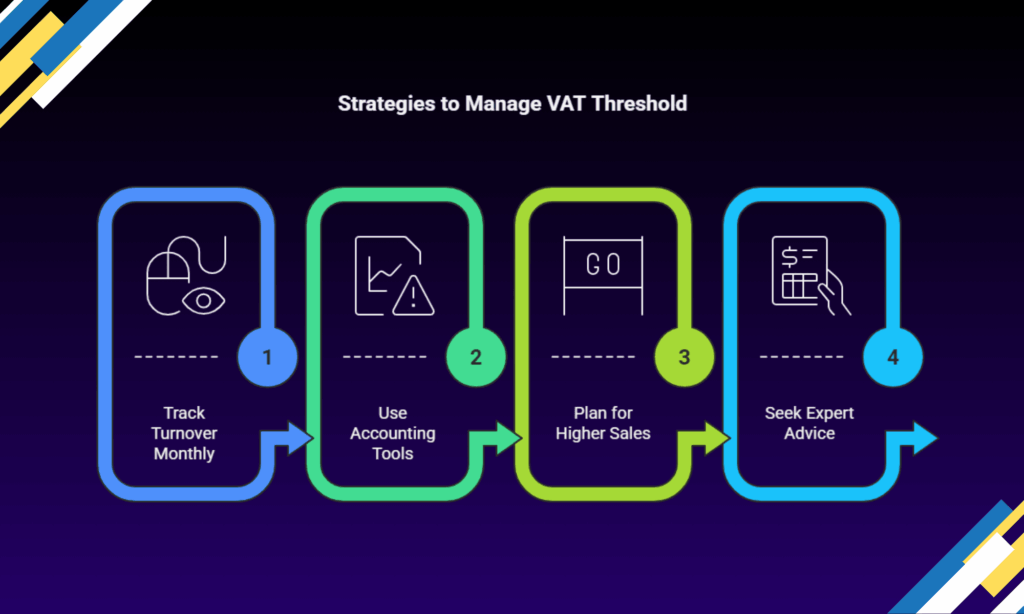
Staying on top of the VAT threshold isn’t just about avoiding penalties it’s about being prepared so your business runs smoothly. A little forward planning can save you a lot of stress later. Here are some simple ways to keep yourself in control.
Track your turnover every month
Don’t leave it until the end of the year. Check your sales monthly so you can see exactly where you stand. If you’re getting close to the threshold, you’ll have time to prepare.
Use smart accounting tools
Modern accounting software can do more than just keep records it can give you alerts when your turnover is approaching the VAT threshold. This makes it easier to act before you go over the limit.
Plan ahead for higher sales
If business is picking up and you’re going to pass the threshold soon, get ready ahead of time. Change your prices, change your invoices, and make sure your systems can handle VAT without any problems.
Get advice from experts
It’s not always easy to understand VAT rules, and every business is different. You can make the right choices at the right time if you talk to a pro. At Path Accountants, we help UK businesses register for VAT, file their returns, and avoid costly mistakes. You can even schedule a free meeting with us to talk about your numbers and get clear, helpful advice.
VAT Threshold for Overseas Businesses
The rules are stricter if your business is not based in the UK. You have to register for VAT as soon as you make your first sale to a UK customer; there is no £90,000 limit. This is very important for online sellers who ship from other countries, because even if you only sell £1,000 worth of goods in the UK, you may still need to register.
Why the VAT Threshold Affects More Than Taxes
When you go over the VAT threshold, you don’t just have to pay VAT. It can also change how your business works. You’ll need to keep better records and stay on top of your paperwork.
- You may have to change your prices to include VAT.
- People can change how they feel about your business. Some people may not like the higher prices, but others may think you are more professional and established.
In short, going over the VAT limit is a financial and strategic choice, so it’s best to plan ahead.
Final Thoughts
The VAT threshold is more than just a number it’s the point where your business can’t go back. You will have to file VAT returns, add VAT to your invoices, and keep accurate records if you go over it. The good news is that you can get back VAT on your business expenses, which can help you save money. The most important thing is to keep your eyes open. No matter where you live in the UK Ilford, London, Wembley, or somewhere else the VAT threshold rules are the same. Keep a close eye on your rolling 12-month turnover and know which sales are included in it.
If you’re unsure where you stand or want expert guidance whether it’s VAT registration in London, VAT advice in Ilford, or VAT help in Wembley book a free consultation now. We’ll review your figures, explain your options, and help you make the right VAT decisions for your business.
FAQs
Are sales to other countries included in the VAT threshold?
If you sell to people outside the UK, those sales usually don’t count towards the VAT threshold. Sales to people in Northern Ireland or sales that fall under certain UK VAT rules are the only exceptions. Before you leave out a sale, make sure you know what kind it is.
What will happen if I accidentally go over the VAT limit?
You still need to sign up as soon as you know you’ve gone over the limit. If HMRC changes the date of your registration, you may have to pay VAT on sales you made in the past. That’s why you should check your turnover every month.
Is it possible for two small businesses to share a VAT threshold?
No, the VAT limit is different for each company. But if HMRC thinks that two businesses are really one business that has been split up to avoid VAT, they can add up the sales and make you sign up.
Is the VAT limit the same for all fields?
Yes. Most businesses in the UK, no matter what they sell or do, have to pay VAT on sales over £90,000. The only difference is that businesses outside the UK that sell to the UK don’t have a limit and have to register from the first sale.
If I unregister from VAT, can I register again later?
If your sales go up again or if you just want to register again, you can do so. Just remember that you have to follow all of the VAT rules from the day you sign up.
Get expert help before your next tax deadline.
Path Accountants helps UK small businesses stay compliant, organised, and tax efficient.

Mohammad Hamza Pathan
ACA Chartered Accountant & Technical Reviewer
ICAEW verified practising certificateMohammad Hamza Pathan is an ICAEW Chartered Accountant and a director of Path Accountants. He reviews Path Accountants guides for technical accuracy, practical relevance and alignment with current UK accounting and tax requirements before publication or substantive updates.
Qualifications and experience
- ICAEW Chartered Accountant (ACA), admitted in 2020 and holder of an ICAEW practising certificate.
- Accountant at Path Accountants and a registered director of Path Accountants Ltd.
- Education listed as Cass Business School.
Professional review areas
- UK tax compliance
- Statutory and company accounts
- Self Assessment
- VAT and Making Tax Digital
- Bookkeeping and payroll
- Small-business accounting
Technical claims, UK terminology, key compliance points and whether the guidance clearly distinguishes general information from advice that depends on a reader's circumstances.