Xero vs QuickBooks for Small Businesses: Which One Actually Makes Sense?
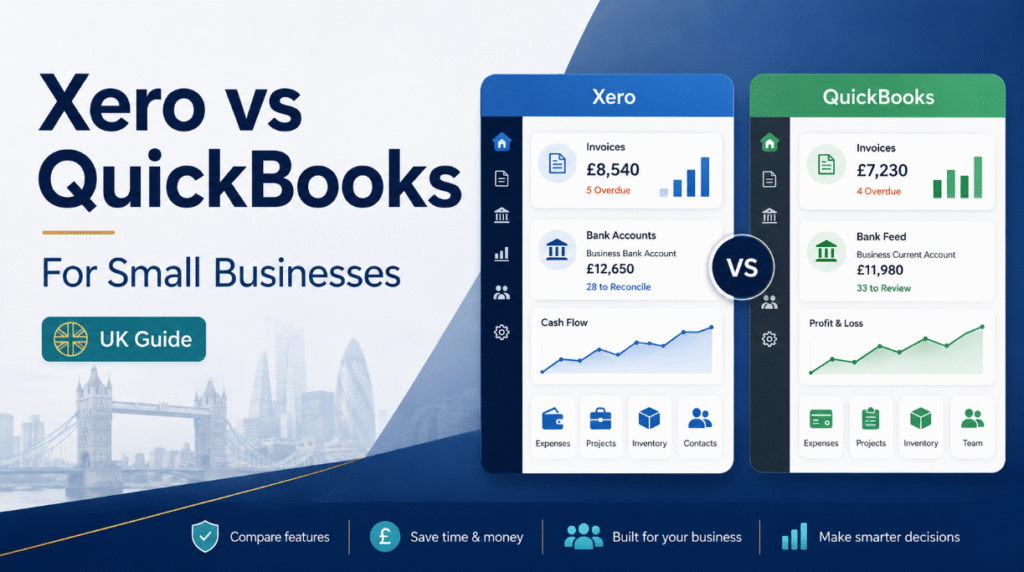
Most small business owners don’t wake up thinking about accounting software. They usually end up comparing Xero and QuickBooks after something starts getting harder than it should be. Invoices get missed. Bank reconciliation takes too long. The accountant keeps asking for cleaner records. Or the business has grown to the point where spreadsheets simply stop working. That’s usually when the Xero vs QuickBooks for Small Businesses decision appears. And the truth is most people are not choosing between good and bad software. They’re choosing between two capable systems that start to feel quite different once real people are using them every week. Neither fixes poor bookkeeping on its own. The right choice depends on how your business actually works. The decision usually starts with a hidden cost problem, not a software problem Most people think they are comparing monthly subscriptions. They’re not. They’re really trying to avoid paying for something they didn’t realise they would need later another user, payroll, expenses, project tools or a higher plan. Xero says its main subscriptions have no per-user licence fees, although some features such as Expenses, Projects and Payroll have their own included usage limits and additional charges. You can see the current details on Xero’s UK pricing page. QuickBooks approaches access differently. Its current UK plans allow: You can check the latest plans directly on the QuickBooks UK pricing page. That difference sounds small until a director, bookkeeper, admin employee and finance person all need their own access. So the useful question in a Xero vs QuickBooks for Small Businesses comparison is not simply, “Which subscription is cheaper today?” It is: How many people are realistically going to need the accounts in the next 6–12 months? Promotional prices change regularly. Team structure normally matters for much longer. If software costs are only one part of a wider finance problem, our guide to bookkeeping costs for small businesses explains what businesses are actually paying for beyond the software subscription. Why some businesses find Xero easier and others barely notice a difference People often describe Xero as simpler, but that doesn’t necessarily mean QuickBooks is difficult. What they normally mean is that Xero keeps common bookkeeping jobs fairly direct. You connect your bank, work through transactions, match what you can and keep moving. QuickBooks puts more information and tools around the same workflow. Some owners like that because they can see more without moving between areas. Others find it busier than they need. Neither approach is automatically better. Think about an ordinary Friday afternoon. There are transactions waiting to be reconciled, two customers haven’t paid and you want to see whether this month was actually profitable. The software that gets you through those jobs without making you think too much is probably the better fit. That matters because complicated software gets ignored. And ignored bookkeeping eventually becomes expensive bookkeeping. If you’re still deciding whether software alone is enough, our guide to small business accounting explains where bookkeeping software ends and proper accounting support begins. Where Xero quietly wins: when more people start touching the accounts A business that starts with one owner rarely stays that simple. Later there may be: This is where Xero’s no-per-user licence structure becomes much more noticeable. You’re less likely to redesign an ordinary bookkeeping process just because another person needs access to the core accounting system. That can work particularly well for agencies, consultancies, growing limited companies and businesses using outsourced finance support. QuickBooks can support teams as well its higher plans currently move from three to five and eventually 25 users. The difference is that user numbers play a bigger part in deciding which QuickBooks plan you need. So for a growing company, Xero vs QuickBooks for Small Businesses can become a seat-cost decision before it becomes a feature decision. QuickBooks starts looking stronger when stock becomes part of everyday life The comparison changes when you sell products rather than time. Now you aren’t only tracking money. You are dealing with products coming in, products going out, supplier orders, returns and the cost attached to what you sell. QuickBooks Plus currently includes inventory management, including product tracking, cost of goods and purchase orders. It also includes project profitability tracking. That makes it attractive if you want more of those jobs handled inside one platform. Xero can still work very well for e-commerce. Plenty of businesses use their accounting platform alongside Shopify, Amazon, payment providers and specialist inventory software. And once stock becomes genuinely complicated, that wider setup often matters more than which accounting logo sits in the middle of it. The better question is: Do you want inventory managed mainly inside your accounting software, or through a specialist system connected to it? For a small online shop, QuickBooks’ built-in inventory may be enough. For a larger operation with several channels or fulfilment systems, integrations can become more important than built-in stock features. Service businesses have a different headache altogether An agency, consultant or freelancer usually doesn’t care about purchase orders for stock. They care about whether invoices went out, whether clients paid and whether projects are actually making money. The everyday priorities are more likely to be: This is where Xero can feel particularly natural because the core bookkeeping workflow stays fairly focused. QuickBooks deserves a serious look where project tracking is important. Its Plus plan includes project profitability, while Essentials includes employee time tracking. For a freelancer or consultancy weighing up the options, our accounting software guide for sole traders looks at the decision from a wider UK perspective. So the service-business version of Xero vs QuickBooks for Small Businesses is really about what you want the system to do beyond the books. Sole traders don’t need more features they need fewer mistakes A sole trader can easily end up paying for features they never use. Most simply need a reliable way to: Making Tax Digital now makes that choice more important for some UK sole traders and landlords. HMRC says people with qualifying self-employment and