Virtual Finance Office

Virtual finance office cost
Virtual Finance Office

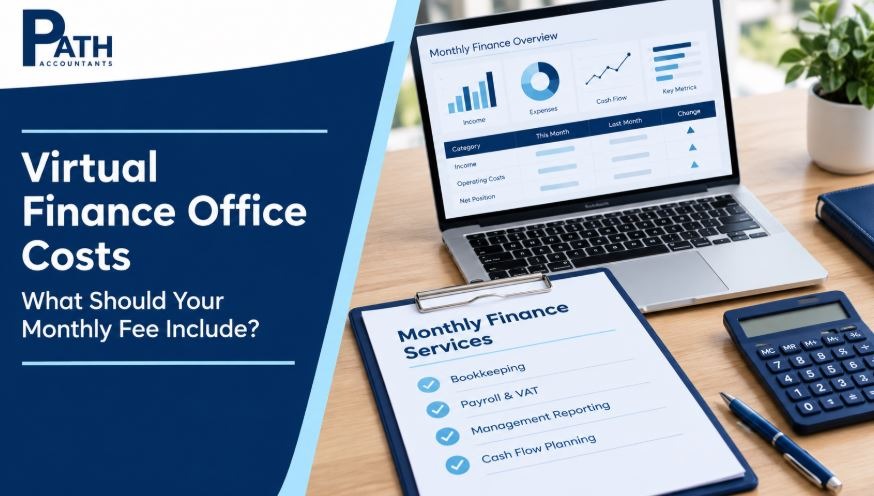
Virtual Finance Office Costs: What Should Your Monthly Fee Include?

Two Virtual Finance Office quotes can look similar until you ask what happens after the bookkeeping is finished. Does the fee include monthly management accounts? Will someone explain why margins have fallen? Are cash flow forecasts updated regularly, or supplied once and forgotten? A Virtual Finance Office, or VFO, should bring agreed finance responsibilities into a coordinated service. Path Accountants structures its offering around operational accounting, management reporting and senior financial support, with the combination tailored to each business. The right price therefore starts with scope, not simply the lowest monthly figure. What Determines Your Monthly VFO Fee? Path accountants VFO service is priced around the work required rather than a published universal tariff. Transaction volumes, payroll, VAT, reporting frequency, entities, systems and record quality all affect the proposed fee. A business with one entity and straightforward monthly reporting needs a different service from a group requiring weekly forecasts, departmental analysis and board reporting. The main cost drivers include: Before comparing quotes, give each provider the same information. Otherwise, the apparent price difference may simply reflect different assumptions. Compare deliverables, not package names “Monthly reporting” might mean an automated profit and loss report. Alternatively, it could include reviewed accounts, balance sheet reconciliations, commentary and a management meeting. Ask for an example reporting pack and a written explanation of what the fee buys. What Should the Monthly Fee Include? Not every business needs every service below. However, your proposal should clearly identify what is included, how often it happens and who is responsible. Service area What to specify in the proposal Bookkeeping and reconciliations Processing frequency, transaction assumptions, bank accounts and reconciliation responsibilities Payroll and VAT Payroll runs, submission responsibilities, approval deadlines and additional charges Month-end close Cut-off dates, accruals, prepayments, reconciliations and review timetable Management accounts Reports supplied, commentary, delivery date and reporting framework Cash flow forecasting Forecast horizon, update frequency, assumptions and scenario work Performance reporting Budget comparisons, KPIs, margins and project or departmental analysis Senior review meetings Frequency, attendees, preparation and follow-up actions Systems and support Software licences, access, integrations and contact arrangements These areas correspond to Path’s three VFO service layers, but they are not automatically included in every engagement. Agree when the information will arrive A report delivered too late may offer little help with the decision you needed to make. Your agreement should define a realistic month-end timetable, including when your team must supply invoices, payroll changes and other information. Clarify what happens when records arrive late and whether reports are provisional or final. For forecasts, distinguish cash monitoring from a maintained forward-looking model. For senior support, establish whether the fee includes scheduled meetings, ad hoc advice or separately commissioned projects. Clear service agreements and responsibility arrangements are central to managing an outsourced finance relationship. Know what remains your responsibility Outsourcing should reduce confusion, not create an assumption that the provider makes every decision. Path distinguishes its finance work from the client’s retained responsibilities, including commercial approvals, customer and supplier relationships, final business decisions and bank authority unless explicitly agreed otherwise. For example, preparing a supplier payment schedule is different from authorising the payment. The Extra Costs Worth Checking Before You Sign A competitive recurring fee can become less attractive if essential work sits outside it. Ask whether the following are included or separately quoted: Also confirm whether VAT is additional, when fees are reviewed, the notice period and how scope changes are approved. A sensible proposal separates one-off implementation work from ongoing monthly delivery. That makes the recurring cost easier to understand and avoids expecting the normal fee to cover substantial historic problems. Is a VFO cheaper than employing someone? It can be, but not automatically. Path’s own comparison recognises this. Compare the capability you need against the total alternative cost, including salary, employer National Insurance, pensions, recruitment, software and supervision. Also consider whether your business needs someone physically present or handling responsibilities outside the proposed VFO scope. Outsourcing can offer flexibility, but the commercial benefit depends on the arrangement and how effectively it works. Why Path Accountants Offers a Practical, Cost-Conscious Solution Path Accountants aims to provide competitively priced support by building the service around the finance capability your business actually needs, rather than requiring you to purchase every layer. Its VFO offering combines: Other features include qualified technical oversight, cloud-based workflows, compatibility with suitable existing systems and the ability to work alongside internal staff. Changing software or replacing your current bookkeeper is not automatically necessary. The value is a coordinated finance function with clearer ownership. As requirements grow, responsibilities and fees can be reviewed rather than rebuilding the arrangement from scratch. Request a Virtual Finance Office review with details of your current providers, software, reporting gaps and priorities. Path can then propose an appropriate scope, timetable and fee. FAQs:


profitable but short of cash and how vfo helps
Virtual Finance Office

Profitable but Short of Cash? How a Virtual Finance Office Helps You Plan Ahead

Your accounts show a profit. Sales are growing. Yet payroll is approaching, suppliers need paying and the bank balance feels uncomfortably low. This does not necessarily mean the accounts are wrong. Profit measures financial performance, while cash flow tracks when money actually enters and leaves the business. A profitable company can still struggle when customer receipts arrive after its own payment commitments. The answer is not simply another spreadsheet. It is a reliable process connecting accounting records, expected payments and management decisions. That is where a Virtual Finance Office can make a meaningful difference. Why Profit Does Not Always Become Available Cash A sale can contribute to profit before the customer pays. Meanwhile, stock purchases, equipment expenditure and loan repayments can absorb cash in ways that do not match the expenses shown in that month’s profit and loss account. Growth can make the problem worse: you may need to fund staff, materials and delivery long before collecting payment. What you see What may be happening to cash Strong invoiced sales Customers have not paid, or invoices are disputed Growing order book Materials and staff must be funded before delivery Healthy project margins Billing milestones lag behind project expenditure Equipment supporting future growth The purchase consumes cash immediately A reassuring bank balance VAT, payroll and borrowing commitments are approaching These are reasons to examine payment timing, working capital and committed expenditure alongside profit. The warning signs worth addressing Repeatedly moving money between accounts, delaying suppliers or relying on the next customer payment to fund payroll should prompt a closer review. Start by asking: ICAEW recommends realistic collection assumptions, scenario planning and visibility over the lowest point of available funding headroom. Build a Forward View, Not Just a Better Historical Report Monthly management accounts explain what happened. A cash flow forecast helps you anticipate what happens next. A rolling 13-week forecast can provide a practical short-term view, particularly where cash is tight. A longer monthly forecast supports decisions about recruitment, investment and funding. The appropriate horizon depends on your business and commitments. What a useful forecast includes Start with reconciled opening cash, then map: Separate confirmed commitments from uncertain sales opportunities. Document important assumptions and test a downside scenario rather than treating every expected sale as guaranteed cash. The forecast should show not only whether cash becomes negative, but when it approaches your minimum operating buffer. Keep it useful through regular review A forecast becomes less valuable when nobody updates it. Compare actual receipts and payments with expectations. If a customer repeatedly pays later than forecast, revise the collection assumption. If a project requires additional subcontractors, update its remaining costs before the invoices arrive. ICAEW emphasises regularly revisiting assumptions and comparing predicted cash requirements with actual outcomes. How Path Accountants’ VFO Connects the Process Cash forecasting depends on more than modelling skills. It needs current records, reliable debtor information, visibility over liabilities and someone responsible for maintaining the process. Path Accountants’ Virtual Finance Office brings operational accounting, management reporting and senior financial support together under an agreed scope. This makes it particularly well suited to businesses whose finance work is scattered across staff, software and separate providers. Reliable records and an agreed timetable Path accountant can coordinate bookkeeping, reconciliations, payroll, VAT workflows and month-end processes. The service begins by defining ownership and establishing a recurring timetable. For cash planning, the proposed scope should specify when records are updated, when the forecast is refreshed and who supplies information about contracts, purchases and expected receipts. Reporting that explains the pressure Path’s Finance Manager layer includes cash monitoring, debtor and creditor visibility, budget versus actual reporting, project reporting and management commentary. Together, these can help distinguish between: That distinction matters because chasing invoices will not solve an underlying pricing problem. Senior input before major commitments Path’s senior support can include cash forecasting, scenario planning, margin analysis and hiring or investment decisions. Where included, review meetings should turn findings into actions: who will resolve disputed invoices, renegotiate billing milestones or reconsider discretionary expenditure? Responsibilities remain clear. Path can prepare reports and forecasts, while the client retains commercial approvals, final decisions and bank authority unless otherwise agreed. Forecasting frequency and senior involvement must be included explicitly in the service scope. How can Path Accountants help us get started? Path begins with a finance function review covering people, systems, processes, reports and deadlines. The VFO scope can then combine the operational work, reporting and senior support your business needs. If profit looks healthy but cash remains unpredictable, ask Path to review your current setup. Bring your latest accounts, debtor balances, borrowing details and upcoming commitments so the discussion starts with the real pressure points FAQs

VFO vs bookkeepers bs CFO
Virtual Finance Office

Virtual Finance Office vs Bookkeeper vs Fractional CFO: Which Does Your Business Need?

If your records need organising, start with bookkeeping. If accounting, payroll and reporting need coordinating, consider a Virtual Finance Office. If reliable figures are available but you need help making financial decisions, fractional CFO support may be the missing piece. These services can overlap, but they solve different problems. The distinction matters when choosing support. You do not want to pay for strategic advice while basic reconciliations remain unfinished. Equally, accurate bookkeeping alone may not answer whether you can afford another employee or fund an expansion. The differences at a glance A useful way to separate the options is responsibility: who maintains the records, who coordinates reporting, and who helps leadership interpret the financial implications of its decisions? ICAEW distinguishes transaction processing, management information and strategic financial leadership within the wider finance function. Area Bookkeeper Virtual Finance Office Fractional CFO Main purpose Maintain accurate transaction records Coordinate recurring finance operations and reporting Provide senior financial direction Typical work Transaction coding, reconciliations and ledger maintenance Bookkeeping, payroll, VAT workflows, month-end and management reporting Forecasting, scenarios, profitability analysis and leadership reviews Main output Current, reconciled records A coordinated finance process and regular reports Financial options, recommendations and agreed actions Best fit Businesses needing dependable record-keeping Businesses needing broader finance capability Leadership teams facing complex financial decisions Key limitation Strategic analysis is not automatically included Senior input depends on the agreed package Requires dependable underlying records These are typical distinctions, not universal package definitions. Confirm the actual deliverables before appointing a provider. Path’s VFO and fractional CFO services explicitly depend on an agreed scope. When a bookkeeper is the right starting point Bookkeeping provides the foundation: recording transactions, maintaining ledgers and reconciling balances. Those records support the wider accounting and reporting process. For a limited company, this is also part of meeting its record-keeping obligations. GOV.UK requires accounting records covering money received and spent, assets, debts, purchases and sales, alongside supporting documentation. Bookkeeping may be your immediate priority if: The first task is establishing reliable records. Once those are available, assess whether you also need management reporting or forecasting. Do not assume every bookkeeper offers identical support. VAT, payroll, credit control and management accounts may require separate agreement. When a Virtual Finance Office makes more sense A Virtual Finance Office, or VFO, brings several finance responsibilities into a coordinated service. At Path Accountants, this can connect bookkeeping, payroll, VAT workflows, month-end processes, management reporting and senior financial input. The difference is not simply that the work happens remotely. It is the agreed ownership of the process. Perhaps your bookkeeper maintains transactions, payroll sits elsewhere, and your year-end accountant receives information later. Each person may complete their task, but nobody coordinates the reporting timetable or resolves gaps between them. A VFO can address that fragmentation by defining: This option suits businesses needing reliable finance operations and regular visibility without building every role internally. It is not automatically better or cheaper than an internal team; the comparison depends on capability, scope and circumstances. When you need a fractional CFO A fractional CFO provides senior financial support on an agreed, part-time basis. The focus is financial leadership rather than daily transaction processing. ICAEW describes the CFO role as overseeing financial direction, budgeting, forecasting, risk and board reporting. The questions are different: Can we afford the proposed expansion? What happens if customer payments slow? Which service lines justify further investment? Path’s fractional CFO work can include cash-flow forecasting, budgeting, scenario modelling, profitability analysis and leadership reporting. Funding preparation can also be included, without guaranteeing finance. However, a CFO cannot replace missing financial foundations. If records are incomplete, the initial work may need to address bookkeeping and reporting before forecasts become dependable. Can these services work together? Yes. They are not competing options, and choosing one does not necessarily mean replacing your existing team. For example, consider a business with a capable internal bookkeeper but no consistent management reporting. It might retain that employee, add outsourced month-end review and introduce CFO support for budgeting and investment decisions. Alternatively, a business with scattered finance responsibilities might need a VFO first, then add senior input once reporting is established. Path’s VFO model allows work to be organised around existing staff and providers, with additional capability introduced where required. How to choose without buying more than you need Before requesting proposals, write down the problem you want solved. “Better financial visibility” is a starting point. “A monthly reporting pack explaining margins, cash movements and overdue customer balances” is a clearer brief. Ask prospective providers: Path’s published pricing factors include transaction volume, payroll and VAT requirements, reporting complexity, systems, data quality and senior input. There is no need to choose by turnover alone. The quality of your records, complexity of operations and decisions ahead provide a more useful starting brief. How Path Accountants helps you choose Path Accountants starts its VFO process by reviewing the existing people, systems, reporting, deadlines and providers. The next step is agreeing what Path accountants handles and what stays in-house. That creates a practical route: The agreed service should identify outputs, responsibilities, reporting dates and fees. Commercial approvals and final business decisions remain with the client. To discuss your requirements, contact Path Accountants with your current finance setup, the main problem and the decision or deadline ahead. FAQs:

Scroll to Top
