Author name: Hamza Pathan

Mohammad Hamza Pathan is an ICAEW Chartered Accountant and the founder and director of Path Accountants, based in London, United Kingdom. His articles aim to make accounting and tax topics clearer and more accessible.

Avatar photo
VFO vs bookkeepers bs CFO
Virtual Finance Office

Virtual Finance Office vs Bookkeeper vs Fractional CFO: Which Does Your Business Need?

If your records need organising, start with bookkeeping. If accounting, payroll and reporting need coordinating, consider a Virtual Finance Office. If reliable figures are available but you need help making financial decisions, fractional CFO support may be the missing piece. These services can overlap, but they solve different problems. The distinction matters when choosing support. You do not want to pay for strategic advice while basic reconciliations remain unfinished. Equally, accurate bookkeeping alone may not answer whether you can afford another employee or fund an expansion. The differences at a glance A useful way to separate the options is responsibility: who maintains the records, who coordinates reporting, and who helps leadership interpret the financial implications of its decisions? ICAEW distinguishes transaction processing, management information and strategic financial leadership within the wider finance function. Area Bookkeeper Virtual Finance Office Fractional CFO Main purpose Maintain accurate transaction records Coordinate recurring finance operations and reporting Provide senior financial direction Typical work Transaction coding, reconciliations and ledger maintenance Bookkeeping, payroll, VAT workflows, month-end and management reporting Forecasting, scenarios, profitability analysis and leadership reviews Main output Current, reconciled records A coordinated finance process and regular reports Financial options, recommendations and agreed actions Best fit Businesses needing dependable record-keeping Businesses needing broader finance capability Leadership teams facing complex financial decisions Key limitation Strategic analysis is not automatically included Senior input depends on the agreed package Requires dependable underlying records These are typical distinctions, not universal package definitions. Confirm the actual deliverables before appointing a provider. Path’s VFO and fractional CFO services explicitly depend on an agreed scope. When a bookkeeper is the right starting point Bookkeeping provides the foundation: recording transactions, maintaining ledgers and reconciling balances. Those records support the wider accounting and reporting process. For a limited company, this is also part of meeting its record-keeping obligations. GOV.UK requires accounting records covering money received and spent, assets, debts, purchases and sales, alongside supporting documentation. Bookkeeping may be your immediate priority if: The first task is establishing reliable records. Once those are available, assess whether you also need management reporting or forecasting. Do not assume every bookkeeper offers identical support. VAT, payroll, credit control and management accounts may require separate agreement. When a Virtual Finance Office makes more sense A Virtual Finance Office, or VFO, brings several finance responsibilities into a coordinated service. At Path Accountants, this can connect bookkeeping, payroll, VAT workflows, month-end processes, management reporting and senior financial input. The difference is not simply that the work happens remotely. It is the agreed ownership of the process. Perhaps your bookkeeper maintains transactions, payroll sits elsewhere, and your year-end accountant receives information later. Each person may complete their task, but nobody coordinates the reporting timetable or resolves gaps between them. A VFO can address that fragmentation by defining: This option suits businesses needing reliable finance operations and regular visibility without building every role internally. It is not automatically better or cheaper than an internal team; the comparison depends on capability, scope and circumstances. When you need a fractional CFO A fractional CFO provides senior financial support on an agreed, part-time basis. The focus is financial leadership rather than daily transaction processing. ICAEW describes the CFO role as overseeing financial direction, budgeting, forecasting, risk and board reporting. The questions are different: Can we afford the proposed expansion? What happens if customer payments slow? Which service lines justify further investment? Path’s fractional CFO work can include cash-flow forecasting, budgeting, scenario modelling, profitability analysis and leadership reporting. Funding preparation can also be included, without guaranteeing finance. However, a CFO cannot replace missing financial foundations. If records are incomplete, the initial work may need to address bookkeeping and reporting before forecasts become dependable. Can these services work together? Yes. They are not competing options, and choosing one does not necessarily mean replacing your existing team. For example, consider a business with a capable internal bookkeeper but no consistent management reporting. It might retain that employee, add outsourced month-end review and introduce CFO support for budgeting and investment decisions. Alternatively, a business with scattered finance responsibilities might need a VFO first, then add senior input once reporting is established. Path’s VFO model allows work to be organised around existing staff and providers, with additional capability introduced where required. How to choose without buying more than you need Before requesting proposals, write down the problem you want solved. “Better financial visibility” is a starting point. “A monthly reporting pack explaining margins, cash movements and overdue customer balances” is a clearer brief. Ask prospective providers: Path’s published pricing factors include transaction volume, payroll and VAT requirements, reporting complexity, systems, data quality and senior input. There is no need to choose by turnover alone. The quality of your records, complexity of operations and decisions ahead provide a more useful starting brief. How Path Accountants helps you choose Path Accountants starts its VFO process by reviewing the existing people, systems, reporting, deadlines and providers. The next step is agreeing what Path accountants handles and what stays in-house. That creates a practical route: The agreed service should identify outputs, responsibilities, reporting dates and fees. Commercial approvals and final business decisions remain with the client. To discuss your requirements, contact Path Accountants with your current finance setup, the main problem and the decision or deadline ahead. FAQs:
overdue limited company accounts
Limited Company

Overdue Limited Company Accounts or CT600? What to Do Before Penalties Escalate

Overdue company accounts and an outstanding CT600 need prompt attention: Companies House and HMRC impose separate penalties, so resolving one does not clear the other. The priority is to establish what remains outstanding, complete accurate filings and address unpaid tax before further charges arise. Check which deadline was missed For most established private limited companies, three dates matter: Obligation Usual deadline Annual accounts to Companies House Nine months after the financial year ends Corporation Tax payment Nine months and one day after the Corporation Tax accounting period ends Company Tax Return to HMRC Twelve months after the Corporation Tax accounting period ends First accounts and changed accounting periods need separate checks; larger companies may have earlier tax instalment deadlines. A Company Tax Return includes the CT600, accounts, tax computations and any required supplementary pages. Understand how penalties escalate Companies House accounts penalties For private limited companies, the penalty depends on when acceptable accounts reach Companies House: How late the accounts arrive Penalty Not more than one month £150 More than one month, up to three months £375 More than three months, up to six months £750 More than six months £1,500 These are penalty bands, not cumulative monthly charges, and the penalty doubles where accounts are late in two successive financial years. Continued non-filing can also expose directors to prosecution and the company to strike-off action. HMRC CT600 penalties For returns with a filing date on or after 1 April 2026, the standard penalties are: For a third consecutive late return, the fixed penalties can reach £1,000 initially and £2,000 in total after three months. Earlier filing deadlines generally fall under the previous £100/£200 standard fixed-penalty rates, so check the original deadline. Late-payment interest is separate from filing penalties; paying tax does not remove the requirement to submit the return. Take these steps now Establish the outstanding position Check the Companies House register, HMRC business tax account and correspondence for each overdue period, including rejected submissions. Do not assume that sending accounts means they were accepted: rejected accounts can still attract penalties if corrected versions arrive late. Gather records and resolve gaps For an initial review, assemble: Incomplete bookkeeping may need catch-up work before reliable accounts and returns can be prepared. File without waiting for cash Do not delay submission simply because the company cannot afford its tax bill: filing and payment are separate obligations. Contact HMRC about a possible Time to Pay arrangement; approval depends on the company’s circumstances and an affordable repayment proposal. The former joint online filing service closed on 31 March 2026; commercial software is now the normal route for Company Tax Returns to HMRC, although Companies House retains other filing options. Assess appeals separately HMRC may accept a reasonable-excuse appeal, but the outstanding return must be filed first. Companies House applies a stricter exceptional-circumstances test; relying on an accountant or being unable to pay is generally insufficient on its own. An appeal is not a substitute for bringing filings up to date. How Path Accountants helps Path Accountants’ company tax preparation service supports overdue returns, year-end accounts and Corporation Tax computations, with connected bookkeeping where required. The process connects the practical stages that an overdue filing needs: Once compliance is restored, Path’s limited company tax planning service addresses future decisions through profit and cash forecasts, director remuneration reviews and scheduled actions. This is separate from retrospective return preparation; the engagement should confirm which services are included. Contact Path Accountants with your outstanding periods, notices and available records to discuss the appropriate scope and next steps. FAQs:

limited company expenses
Limited Company

Limited Company Expenses: What Can the Business Claim and What Needs Separate Treatment?

A business purchase does not become tax deductible simply because you paid with the company card. Limited companies can generally deduct qualifying running costs when calculating Corporation Tax, but capital purchases, private spending and employee benefits need different treatment. For directors, the challenge is knowing which category applies before a transaction reaches the accounts. Getting that distinction right helps prevent missed deductions, incorrect VAT claims and unexpected personal tax liabilities. What Makes an Expense Allowable? For a trading company, revenue expenditure generally needs to be incurred wholly and exclusively for the business and must not be specifically disallowed. Client entertaining, for example, is normally disallowed even where there is a genuine commercial reason for it. Where business and private elements are clearly separable, the business portion may qualify. However, assigning an estimated business percentage does not automatically make a mixed purpose purchase allowable. Before claiming, ask: What was the business reason for the expenditure? Does it belong to the company or the director? Is it a running cost, an asset or employee remuneration? What evidence supports the proposed treatment? Common Expenses and Their Treatment The following table is a starting point, rather than permission to claim every purchase within a category. Expense Usual company treatment What needs checking Accountancy and bookkeeping Routine company accounting costs are normally deductible Separate company work from personal advice. Office rent, utilities and insurance Business running costs generally qualify Private expenditure must be identified separately. Software subscriptions and advertising Routine business costs generally qualify Some substantial projects or acquired rights require different treatment. Salaries and employer pension contributions Generally deductible where the relevant conditions are met Payroll, commercial purpose and pension rules still apply. Business travel and accommodation Qualifying work travel can receive favourable treatment Ordinary commuting and private extensions need separate consideration. Computers, machinery and equipment May qualify for capital allowances Do not assume an immediate revenue deduction. Client meals and hospitality Normally disallowed for Corporation Tax Business purpose alone does not override the restriction. Director’s personal spending Not automatically a business expense Consider repayment, remuneration, benefits or the director’s loan account. Costs That Need Separate Treatment Equipment and capital purchases A laptop, machine or van bought for continuing business use may be a capital asset rather than an everyday expense. The company may obtain relief through capital allowances, subject to the asset and the applicable conditions. For equipment provided to employees or directors, personal use creates another question. Business equipment can qualify for an employment tax exemption where the relevant conditions are met and private use is not significant. The company’s tax relief and the director’s benefit position must be checked separately. Travel, commuting and meals Business travel should be supported by journey records explaining where the person travelled and why. Payments for using a personally owned vehicle follow mileage rules, which differ from the rules for company vehicles. Ordinary commuting is not qualifying business travel. Similarly, a meal bought during a normal working day is not automatically subsistence simply because work was discussed; genuine business travel and employee benefit rules need consideration. Working from home and phone bills Limited company directors should not simply copy the household expense methods used by sole traders. Under qualifying homeworking arrangements, the company can pay £6 weekly, or £26 monthly for monthly paid employees, towards additional household costs without evidence of the exact expenditure; larger payments need justification. This employer payment route remains distinct from personal tax relief for unreimbursed homeworking costs, which was removed from 6 April 2026. Phone arrangements also matter. Reimbursing an employee’s personal monthly mobile tariff can require payroll treatment, rather than being a straightforward tax free reimbursement. Staff benefits and entertainment A cost can be deductible for the company while creating a taxable benefit for the employee. Private medical insurance is a common example, so Corporation Tax treatment must not be confused with personal tax exemption. Qualifying annual staff functions can be exempt where they are open to all employees and meet the £150 per person conditions. This is an exemption, not an allowance to deduct from any event bill, and client hospitality follows different rules. Paying Personally or Using Company Funds If a director pays a genuine company cost personally, reimbursement may be possible, provided the expenditure meets the relevant rules and supporting records are retained. The reverse needs care. If company funds pay a private bill, the transaction may require repayment, payroll treatment or recording through the director’s loan account. An outstanding director’s loan can create additional company tax consequences. Dividends are different again: they are distributions of profit, not deductible business expenses. VAT Requires Its Own Review A Corporation Tax deduction does not automatically establish a right to recover VAT. VAT recovery depends on the relevant VAT rules, the nature of the purchase and supporting documentation. For expense processing, practical controls should include: Keeping the invoice or receipt against each transaction Recording the business purpose and relevant attendees Checking VAT evidence rather than relying only on bank statements Separating employee entertaining from client entertaining Reviewing reimbursements before posting them to the accounts. Company accounting records generally need to be retained for six years from the end of the relevant financial year, with longer retention required in certain circumstances. Why Choose Path Accountants? Path Accountants supports limited companies with connected bookkeeping, company accounts, Corporation Tax, VAT and payroll services, alongside practical guidance on business expenses and director remuneration. Its dedicated accountant approach provides continuity, while the proposed scope and fees are agreed before work begins. Services can be coordinated around the company’s records, deadlines and decisions, rather than treating each filing as an isolated task. Frequently Asked Questions Can every company card payment be claimed? No. The payment method does not determine deductibility. Business purpose, capital or revenue classification and specific restrictions determine the Corporation Tax treatment. Can the company claim expenses without receipts? Missing receipts do not remove the need for evidence. Obtain replacement invoices where possible, document the transaction and remember that VAT recovery generally requires

limited company year end tax planning
Limited Company

Limited Company Year-End Tax Planning: What to Review Before Your Accounting Period Ends

A busy year can leave surprisingly little time to look at the numbers. Sales have grown, costs have crept up, and money has moved between the company and its directors. Then the year-end arrives, followed by a tax bill nobody quite expected. The useful conversations happen before that point. Once your accounting period has ended, some planning opportunities have passed, even though your accounts and tax return are not due yet. For an owner-managed limited company, year-end planning means checking the figures, understanding the likely tax bill and making sensible decisions while there is still time. Start with a reliable profit forecast Your bank balance will not tell you how much Corporation Tax the company owes. It may include VAT, customer deposits or money needed to settle suppliers. Equally, unpaid sales invoices may contribute to accounting profit despite the cash not having arrived. Bring the bookkeeping up to date before discussing tax-saving ideas. Reconcile bank accounts, check unpaid invoices and make sure payroll, expenses and purchases are recorded. Then ask your accountant for an estimated taxable profit. This can differ from the profit shown in your accounts because some costs are disallowed and capital allowances replace accounting depreciation for tax purposes. Check which Corporation Tax rate applies For eligible companies, the small profits rate is 19% on profits of £50,000 or less. The main rate is 25% above £250,000, with marginal relief potentially available between those limits. Those thresholds are not universal. They reduce for short accounting periods and where there are associated companies. If you control another company, mention it even if the businesses operate separately. This matters when assessing a proposed expense or pension contribution. The tax saving depends on the company’s circumstances, not simply a blanket assumption that every deduction saves 19% or 25%. Review spending without buying things unnecessarily There is little sense in spending £10,000 on something the business does not need just to reduce tax. You still have to fund the purchase. However, if equipment genuinely needs replacing, review the timing before year-end. Qualifying expenditure may receive relief through the Annual Investment Allowance, which generally permits a deduction of up to £1 million for a 12-month period. Companies may also qualify for full expensing on eligible new and unused plant and machinery. Cars have separate rules. Before committing, check: Do not assume placing an order before year-end automatically secures relief in that period. Capital allowance timing follows specific rules. Consider employer pension contributions early A company pension contribution can be worth discussing where the director wants to build retirement savings and the business has surplus cash. For tax relief, employer contributions generally need to be paid during the accounting period. An unpaid year-end provision is not enough. The contribution must also meet the relevant deductibility conditions. The standard pension annual allowance is £60,000 for 2026/27, but that does not mean every director can contribute that amount without further checks. Employer contributions count towards the allowance, and high income or previous flexible pension access can reduce it. Leave time to check the position and arrange payment. Pension planning should also consider your personal circumstances and access to the money, not just the company’s tax bill. Separate dividends from company tax deductions A dividend does not reduce Corporation Tax. It is a distribution to shareholders from available profits, rather than a deductible business expense. Before declaring one, check the company’s distributable profits using reliable accounts. Cash in the bank alone is not sufficient evidence. Keep the required minutes and dividend vouchers, including where there is only one director and shareholder. Also distinguish the company’s year-end from your personal tax year, which ends on 5 April. They may not match. A sensible remuneration review considers both calendars rather than rushing out a dividend simply because the company’s accounting period is ending. Look closely at the director’s loan account Personal purchases paid by the company and withdrawals not covered by salary, dividends or expense repayments can create a director’s loan balance. Ask for a breakdown before year-end. Misclassified transactions may need correcting, while genuine borrowing needs a repayment plan. An outstanding loan to a shareholder-director can trigger a separate company tax charge if it remains unpaid beyond the relevant post-year-end period. Temporary repayments followed by fresh borrowing may fall within anti-avoidance rules. Do not clear the account with an unsupported dividend or backdated paperwork. Establish what the transactions actually represent first. Agree the remaining actions A short written plan is more useful than a long conversation with no follow-up. Review area Practical action before year-end Bookkeeping Resolve missing records and reconcile balances Tax forecast Estimate taxable profit and reserve cash Equipment Confirm commercial need, eligibility and timing Pensions Check allowances and arrange payment where appropriate Dividends Confirm available profits and documentation Director’s loan Verify the balance and agree next steps These checks bring together the records, capital allowance, pension and profit-distribution requirements discussed above. Keep cash available after the year-end For most smaller companies outside quarterly instalment payments, Corporation Tax is due nine months and one day after the accounting period ends. The Company Tax Return is normally due after 12 months. Paying and filing are separate obligations. Start reserving cash before those deadlines approach. A tax-efficient decision that leaves the business unable to pay wages, suppliers or VAT is not a good outcome. Put the review in the diary The best year-end plan is usually practical, not elaborate: accurate records, a realistic forecast and a few decisions made at the right time. For London company directors, Path’s dedicated accountants in London and across UK help turn those figures into a clear discussion about company tax, remuneration and ongoing reporting. Arrange the review before your accounting period ends, while there is still room to act. also add how path accountants help with solid content ideas to attract leads How Path Accountants Can Help Before Your Company Year-End You do not need another generic tax checklist. You need to know what your company is likely to owe, which

director salary or dividend
Limited Company

Salary or Dividends? A Tax Planning Guide for Limited Company Directors

For many owner-directors, a combination of salary and dividends can be tax-efficient. But there is no universal “best director’s salary”. The right balance depends on your company’s profits, other personal income, National Insurance position and eligibility for Employment Allowance. The key is to compare the combined company and personal tax cost. This guide uses rates for the 2026/27 tax year, from 6 April 2026 to 5 April 2027. Salary and dividends: what is the difference? Salary pays you for working in the business. Dividends reward you as a shareholder. Being a director does not automatically entitle you to dividends: you must hold shares carrying the relevant rights, and the company must have sufficient available profits. Issue Salary Dividends Company tax treatment Generally deductible where incurred wholly and exclusively for the business Not deductible for Corporation Tax Personal tax Subject to Income Tax, depending on allowances and income Subject to dividend tax after applicable allowances National Insurance Employee and employer contributions may apply No National Insurance on genuine dividends Payment requirements Operated through payroll, with PAYE reporting Available profits, appropriate approval and dividend vouchers Low-profit periods Can be paid without distributable profits, subject to affordability and directors’ duties Cannot exceed available profits Salary, payroll and dividend requirements are explained in the government’s guidance on taking money out of a limited company. What are the main thresholds for 2026/27? Threshold or rate 2026/27 position Standard Personal Allowance £12,570 Employee National Insurance threshold £12,570 annually Employer National Insurance threshold £5,000 annually Standard employer National Insurance rate 15% above the threshold Dividend allowance £500 Dividend tax rates 10.75% basic; 35.75% higher; 39.35% additional Employment Allowance Up to £10,500 for eligible employers These figures assume the relevant standard treatment; individual circumstances can change the outcome. Scottish Income Tax bands differ for salary, although the dividend rates above apply across the UK. Your total income determines which dividend bands are available. Why a £12,570 salary is not automatically tax-free A director with an unused Personal Allowance may pay no Income Tax or employee National Insurance on an annual salary of £12,570. However, the company generally pays employer National Insurance on the amount above £5,000 unless an allowance or exemption covers it. That does not automatically make a lower salary better. Salary and associated employer National Insurance can generally reduce taxable business profits, while dividends cannot. A proper comparison considers that company tax relief alongside payroll costs and your personal tax. Crucially, a single-director company cannot claim Employment Allowance where that director is its only employee liable for employer National Insurance. Simply employing someone below the relevant threshold does not overcome this restriction. Are dividends always more tax-efficient? No. Dividends avoid National Insurance, but they come from profits available for distribution after accounting for Corporation Tax. Companies generally pay 19% on qualifying small profits, 25% at the main rate, or an effective rate reflecting marginal relief between the thresholds. The £500 dividend allowance is not an extra basic-rate band. Dividend income still counts when determining your tax band, even where the allowance means no dividend tax is payable on part of it. Also, cash in the company bank account is not proof that a dividend is lawful. Review accumulated profits, losses, tax provisions and previous distributions before approving payment. Keep meeting minutes and dividend vouchers. How different director scenarios change the answer You have another job or pension income Your Personal Allowance may already be used. A salary from your company could therefore attract Income Tax immediately, while dividends may fall into higher tax bands. Review all income together rather than applying a standard salary-and-dividend template. Your company has employees Employment Allowance may reduce employer National Insurance if the company qualifies. This can change the salary comparison, but eligibility must be checked against the full conditions. Your profits fluctuate Avoid committing to dividends based on expected future profits. Use current accounting information and review available reserves before each distribution. A regular withdrawal should not automatically be labelled a dividend. Your income approaches £100,000 The Personal Allowance reduces by £1 for every £2 of adjusted net income above £100,000. Additional withdrawals can therefore have consequences beyond the headline dividend rate. You do not need all the money personally Consider whether retaining funds for working capital or making employer pension contributions better supports your plans. Employer pension contributions can qualify for company tax relief where the relevant conditions are met; pension allowances and access restrictions also need consideration. How to Avoid common Mistakes? How Path Accountants can help you? Our dedicated accountants can help you turn these moving parts into a practical director-pay plan, with the scope agreed before engagement: Before your next withdrawal, discuss your company’s profits, existing salary, dividends already received and other income with Path Accountants. The aim is a documented, affordable remuneration plan.

AUTUMN BUDGET 2026 UK
UK Tax and Accounting

Autumn Budget 2026: What It Means for Small Businesses, Landlords and Limited Companies

Chancellor John Healey delivered his first Budget today, 28 October 2026, and for most London businesses the message is stability rather than shock. There are no rises to the main rates of income tax, National Insurance, VAT or corporation tax. Instead, the Treasury says it is raising money in a “targeted” way, and some of those targets land squarely on landlords, business owners planning an exit, and anyone with significant savings income. Here is what today’s announcements mean for small businesses, landlords and limited companies in London, based on the government’s own Budget documents and early analysis from tax professionals. Budget 2026 at a glance Measure What changes Takes effect Tax on rental profits Rises to 24% (basic), 44% (higher) and 49% (additional) in England, Wales and Northern Ireland 6 April 2027 Tax on savings income Rises to 24%, 44% and 49% across the UK 6 April 2027 Corporation tax Main rate stays 25%, small profits rate stays 19% Confirmed for the year from 1 April 2028 Dividend tax No change — Business Asset Disposal Relief Lifetime limit halved from £1m to £500,000 Disposals from 6 April 2027 Founders’ Relief (new) 10% CGT on up to £10m of lifetime gains for qualifying founders Disposals from 6 April 2027 Capital allowances Main rate first-year allowance up to 50%; writing-down allowance cut to 12% 1 January 2027 / 1 April 2027 Trading allowance Tripled from £1,000 to £3,000 6 April 2027 Business mileage above 10,000 miles Up from 25p to 35p per mile 6 April 2027 National Living Wage Up 3.9% to £13.21 per hour 1 April 2027 Source: HMRC Budget 2026 Overview of Tax Legislation and Rates and HM Treasury. Landlords: the biggest losers Individual landlords are hit hardest. Last year’s Budget had already set separate property income tax rates of 22%, 42% and 47% from April 2027. Today the Chancellor added a further two percentage points, so from 6 April 2027 rental profits will be taxed at 24%, 44% and 49% in England, Wales and Northern Ireland. As a simplified illustration, if £20,000 of taxable property income falls entirely within the higher-rate band, a rise from 40% to 44% would increase the tax on that income by £800 a year, before considering other changes in circumstances, allowances or reliefs. Of this, £400 reflects the additional two-percentage-point increase announced today; the other £400 reflects the previously announced increase. The rise does not apply to companies, which pay corporation tax on rental profits instead. Bishop Fleming notes that the change increases the tax burden on individual landlords and property partnerships compared with corporate landlords. That makes it a good time to review whether your portfolio is held in the right structure, although incorporating an existing portfolio can trigger capital gains tax and stamp duty, so take advice first. Limited companies and business owners The main Corporation Tax rate remains 25%, with a 19% small-profits rate. Generally, the small-profits rate applies to profits of £50,000 or less, while marginal relief may apply between £50,000 and £250,000. These thresholds are reduced for short accounting periods and where a company has associated companies. Certain companies are excluded from the small-profits and marginal-relief rules. The main changes for companies are: If you are planning to sell or close your company in the next year or two, the BADR change is the one to act on now. Special rules apply to contracts signed before 6 April 2027 but not yet completed. Small businesses, sole traders and employers There is good news for London’s high streets and side businesses, alongside tougher rules on how tax is paid. Longer term, HMRC is tightening collection. From April 2029, businesses must set up Direct Debits for VAT and PAYE, and Self Assessment taxpayers who make payments on account will pay more regularly during the year. What should you do now? Most of today’s changes start on 6 April 2027, which gives you just over five months to plan. Three steps are worth taking now: Many details, including Founders’ Relief, are still subject to consultation and Parliament, so the final rules may change. Speak to Path Accountants Every business and property portfolio is different, and the right response to this Budget depends on your income, your structure and your plans. Path Accountants’ London tax experts can review your position, model the impact of the new rates, and help you plan before April 2027. Book a free consultation with our team today.

monthly management accounts
Outsourced Accounting

Monthly Management Accounts for London SMEs: What Good Ones Show and How a Virtual Finance Office Delivers Them

Good monthly management accounts explain profitability, cash and financial commitments. Path Accountants’ Virtual Finance Office connects the underlying records, month-end reporting and financial interpretation through an agreed service scope. For a London SME deciding whether to recruit, renew premises or take on another contract, the reporting test is practical: what has changed, why does it matter, and what needs doing next? What Management Accounts Should Show Management accounts support internal decisions rather than replace annual statutory accounts, and their content should reflect the business’s needs. Use the following as a reporting brief, not a compulsory template. Reporting area What to ask for Decision it supports Profit and loss Monthly and year-to-date sales, direct costs, overheads and profit, with budget comparisons. Review pricing, spending and performance Balance sheet Assets, customer debts, supplier balances, borrowing and other liabilities. Understand the position behind the profit Cash position Actual receipts, payments and available cash, alongside a separately identified forecast. Assess upcoming payment capacity Debtors and creditors Outstanding balances, overdue items and expected payment dates. Prioritise collections and supplier payments Relevant KPIs Measures linked to the business model, such as margin, labour costs or project performance. Investigate operational causes Management commentary Explanations of significant differences and recommended responses. Turn reporting into action For London businesses, build the pack around actual commitments: premises costs, staffing, supplier terms and the profitability of each service or location. Avoid filling a dashboard with measures nobody uses. Reliable Numbers Need Month-End Checks A software-generated profit and loss report is a starting point, not proof that the reporting period is complete: accruals, prepayments, depreciation and receivables adjustments can change both profit and balance-sheet figures. Before accepting the pack, ask whether the preparation process covers: For example, an annual insurance payment should not automatically become an expense of the payment month when the cover relates to several periods. Otherwise, a timing issue can distract management from the underlying trading result. Profit Is Not Available Cash A profitable business can still struggle to pay suppliers while waiting for customers to settle invoices. That makes cash reporting essential alongside the profit figure. Ask the monthly review to connect the trading result with collections, payments and upcoming commitments. Keep historical cash movements separate from forecasts, and challenge the expected collection dates rather than assuming every invoice will arrive on time. How Path Delivers Useful Reporting Path’s Virtual Finance Office offers three connected levels: operational finance, management reporting and senior financial support, with responsibilities selected around the business’s requirements. Establish Ownership And Deadlines Path accountants start by reviewing existing people, systems, processes and reports, then agrees which responsibilities sit with Path and which remain in-house. The service establishes a recurring timetable covering bookkeeping, payroll/VAT dates, month-end close and reporting. Agree an information-submission deadline and a reporting date upfront. Otherwise, “monthly accounts” can describe the period covered without explaining when management will receive them. Connect Records And Reporting Where included, Path can coordinate bookkeeping, reconciliations, payroll, VAT workflows and month-end processes rather than leave those tasks disconnected. Its Finance Manager support can add monthly management accounts, budget comparisons, KPIs, project or department reporting and commentary. For a project-based business, request reporting that connects revenue with delivery costs and outstanding customer balances. This focuses the discussion on which work earns a worthwhile return and which invoices need attention. Add Forward-Looking Financial Support Path’s senior support can include forecasts, scenario planning, margin analysis and hiring or investment decisions where agreed. This is an additional capability that every reporting package includes CFO-level advice. Before approving a new hire, for instance, ask to test affordability against realistic customer-payment timing, not profit alone. Agree who will take each resulting action and when it will be reviewed. Keep Control And Accountability Clients retain commercial approvals, final business decisions and bank authority unless explicitly agreed otherwise. Limited-company directors also remain legally responsible for company records, accounts and performance despite appointing an accountant. Build A Better Monthly Review Explore Path Accountants’ Virtual Finance Office to discuss the reporting, responsibilities and financial support appropriate for the business. Request a proposal identifying the pack’s contents, delivery timetable, review arrangements and fee before work begins. FAQs

move finances to outsourced team
Outsourced Accounting

How to Move Your Finance Function to an Outsourced Team

Outsourcing your finance function should make running your business easier not leave you wondering who is processing payroll or whether the next VAT return is covered. Perhaps your bookkeeper is stretched, your accountant only appears at year-end, or you spend evenings matching receipts instead of managing the business. For a retailer reconciling card payments or a London contractor chasing customer invoices, disconnected finance processes can quickly become a distraction. The answer is not simply to send everything to a new provider. A successful move needs clear ownership, reliable records and an agreed timetable. Here is how to organise the transition. 1. Identify What Needs to Change Are invoices being entered late? Do payroll changes arrive at the last minute? Are you looking at profit figures without understanding the cash available? List the tasks currently handled by you, employees and external advisers. Include bookkeeping, payroll, VAT, customer collections, supplier payments, management accounts and year-end work. Then decide which tasks to outsource and which should remain internal. You do not have to replace an existing bookkeeper: Path’s service can cover selected functions or work alongside your current team. 2. Agree the Scope Before Signing “Full accounting support” can mean different things to different providers. Your proposal should specify the work, frequency, responsibilities and fee. For example, bookkeeping does not automatically include chasing overdue invoices. Preparing a supplier-payment schedule does not necessarily include authorising payments. Area What to agree Bookkeeping Processing frequency, reconciliations and document requirements Payroll Input deadlines, review process and submission responsibilities VAT Records, return preparation and approval arrangements Reporting Reports included, delivery dates and review meetings Payments Who prepares, checks and authorises transactions Historic issues Scope and pricing for catch-up or correction work Path builds its outsourced service around an agreed responsibility map and monthly timetable, rather than assuming every business needs the same package. 3. Choose a Controlled Handover Date Choose a date that allows the outgoing and incoming teams to reconcile responsibilities. A completed payroll run or accounting month-end can provide a useful reference point. Before confirming the date, identify: Record who will complete each outstanding task. Avoid a gap where both providers assume the other is handling a return. Path reviews upcoming deadlines, existing records and information availability before setting an onboarding plan; it does not promise a standard transition time without reviewing the work. 4. Transfer Records and Check Balances Giving the new team software access is only part of the handover. The records also need to be understandable. Prepare the latest accounts, trial balance, bank reconciliations, customer and supplier balances, VAT records, payroll information and relevant loan agreements. Ask the incoming team to identify discrepancies requiring investigation. For example, old unpaid invoices, duplicate transactions or unexplained director balances. For a retailer, this might mean reconciling card settlements after processing fees. For a contractor, it might involve separating outstanding invoices from retentions. Keep historic clean-up work separate from the ongoing service so its scope, cost and timetable are clear. Companies must retain adequate accounting records, including money received and spent, assets, liabilities and supporting documents. 5. Protect Payroll Continuity Payroll deserves its own transition checklist. Employees should not experience uncertainty because the finance provider changes. Confirm employee details, year-to-date figures, tax codes, deductions, pension information and payroll identifiers before the first live run. If software or payroll IDs change, the migration must be handled correctly. HMRC warns that incorrect payroll-ID changes can create duplicate employment records and disputed PAYE charges. Path provides payroll processing based on agreed pay frequencies, employee information and cut-off dates. Any migration requirements should be reviewed during onboarding rather than discovered on payday. 6. Secure Access Without Losing Control Agree how documents will be shared, who can access each system and how access will be removed when no longer needed. Use named user accounts and appropriate permissions rather than circulating shared passwords. Confirm who controls subscriptions and retains access to the records. Also clarify data-protection responsibilities: an accountant’s role depends on the processing involved, so do not assume every outsourced arrangement has the same controller–processor relationship. Most importantly, outsourcing does not transfer a director’s legal responsibilities. Directors remain responsible for the company’s records, accounts and performance, even when an accountant manages tasks day to day. 7. Establish the First Reporting Cycle The first month should have a practical operating schedule. Agree: Then test the process. Can you understand outstanding customer balances? Are supplier liabilities complete? Does the reporting explain the difference between profit and cash? Path’s service includes agreed monthly workflows and periodic management accounts, with the scope reviewed as business requirements change. How Path Accountants Can Help Path Accountants is based in Wembley and provides remote outsourced accounting support across the UK. Its service covers full or partial outsourcing, including bookkeeping, payroll, VAT workflows and year-end coordination. Its approach addresses several practical transition needs: For broader forecasting and finance-process ownership, Path also directs businesses to its Virtual Finance Office service. Book a free consultation with your transaction volumes, employee count, VAT status, software details and next key deadline. These facts help establish a realistic scope before you commit. FAQs:

switch accountants in london
Business Advisory

How to Switch Accountants in London: A Practical Checklist

Changing accountants can feel like another job you do not have time for. Perhaps emails go unanswered, fees are unclear or your accounts arrive too late to help you make decisions. For a Wembley shop owner in London balancing stock and staffing, or a contractor managing invoices between jobs, uncertainty over the numbers can become frustrating. The good news is that switching does not need to mean starting from scratch. With a planned handover, you can move your records, establish responsibilities and keep important deadlines visible. Here is how to approach the change and how Path Accountants can help. When Should You Consider Switching? An occasional delay does not necessarily mean you need a new accountant. However, persistent problems deserve attention. You may want to review your options if: Before switching, explain your concerns to your current accountant. Sometimes a clearer scope or different reporting arrangement resolves the issue. If not, begin comparing alternatives before ending the existing relationship. How to switch accountants in London: Step-by-step 1. Define the Support You Need A self-employed consultant may mainly need annual accounts and Self Assessment support. A limited company with employees may require bookkeeping, VAT, payroll, Corporation Tax and regular reporting. Write down: For London businesses with both shop sales and online orders, for example, ask how card settlements, platform fees and refunds will be reconciled. Path Accountants offers packages for sole traders, limited companies and growing businesses, with the final scope and fee agreed before appointment. 2. Compare Scope, Not Just Fees Two monthly quotes may cover very different work. A lower price is not necessarily better value if essential services are additional. Ask before appointing Why it matters What does the monthly fee include? Establishes responsibility for bookkeeping, returns and advice Is catch-up work charged separately? Prevents overdue work being overlooked Are software subscriptions included? Clarifies the total ongoing cost Who will answer my questions? Sets expectations about communication What happens after an introductory offer? Makes the continuing cost clear How are deadlines and approvals managed? Reduces uncertainty during the handover Path currently advertises 30% off the agreed monthly fee for the first three months for eligible switching clients. Standard fees apply afterwards; confirm eligibility and terms during your consultation. 3. Check Your Existing Agreement Read your current engagement letter before giving notice. Check any notice requirements, outstanding invoices, subscription arrangements and work already commissioned. Then notify your accountant in writing. Keep the message professional: “I have decided to appoint a new accountant. Please confirm any outstanding work and fees, and cooperate with the transfer of relevant information once you receive my authority.” Agree who will complete any return already underway. Do not assume that stopping a direct debit ends the engagement or settles responsibility for unfinished work. 4. Arrange Professional Communication After appointment and with your authority, the new accountant can contact the outgoing firm. Often called “professional clearance”, this communication helps the incoming accountant identify relevant professional matters and obtain handover information. It is not simply a request for permission to change providers. ACCA guidance requires its members to provide reasonable transfer information promptly and without charge. That includes the latest client-approved accounts and an associated detailed trial balance. Other records, additional work and ownership questions may require separate consideration. Path Accountants can begin the professional-clearance and records-request process after appointment. The timetable depends on your records, outstanding work and how quickly information is supplied. 5. Prepare Your Handover Checklist The documents required depend on your business, but this is a useful starting point: Area Information to gather Accounts Latest approved accounts, trial balance and available bookkeeping records Tax Recent returns, tax references and relevant HMRC correspondence VAT Registration details, recent returns and supporting records Payroll Payroll reports, year-to-date figures and employer references Banking Statements, finance agreements and reconciliation information Software Subscription ownership, administrator access and data exports Company records Relevant company details and director/shareholder information For a small business, software ownership can be particularly important. Confirm who pays for the subscription and how access will continue before cancelling anything. Keep your own secure copies of important records. 6. Update HMRC Authorisation Appointing a new accountant does not automatically provide access to every HMRC service. The authorisation process depends on the tax involved and may use an online service or form 64-8. A new authorisation generally replaces the existing authority for the relevant service, so check each area separately. Review Self Assessment, Corporation Tax, VAT and PAYE as applicable. Use HMRC’s proper authorisation process rather than giving someone your personal sign-in credentials. 7. Agree the First Month’s Priorities Before considering the switch complete, confirm: This matters whether you run a retail business in London, manage a small company remotely or work independently across London. A local appointment is useful, but clear ongoing responsibilities matter just as much. How Path Accountants Can Help Our dedicated accountants for London supports the transition by reviewing your requirements, agreeing the service scope and beginning the professional-clearance and records-request process after appointment. The aim is not merely to replace one name with another. It is to establish accounting support that fits your business, with clearer fees, practical next steps and an agreed onboarding timetable. If you are considering switching accountants in Wembley or anywhere in London, request an initial conversation with our team. Explain what is not working, what deadlines are approaching and what you need from the relationship. You can then assess the proposed package before deciding to proceed. FAQs

Best Outsourced Finance Function in London
Business Advisory

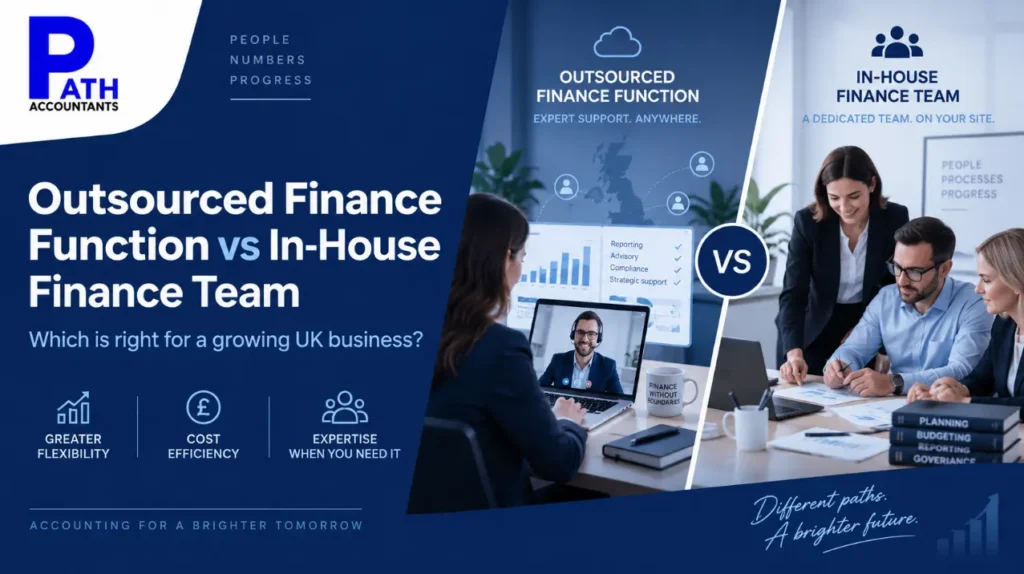
Outsourced Finance Function vs In-House Finance Team: Which Is Right for a Growing UK Business?

As a business grows, its finance requirements rarely grow neatly one role at a time. A company may need better bookkeeping, tighter month-end processes, payroll support, VAT management, cash-flow forecasts and more useful management information without necessarily having enough work to justify employing a full-time specialist for every function. That creates an important decision: should you build an internal finance department or use an outsourced finance function? The answer is not simply that one model is better than the other. An outsourced finance function vs in-house finance team decision should be based on the amount of day-to-day finance involvement the business requires, the range of expertise needed, how quickly those requirements are changing and whether there is enough work to justify permanent internal roles. For some growing businesses, outsourcing can provide broader finance capability without immediately building a department internally. For others, having finance employees embedded in the business every day is more practical. Outsourced Finance Function vs In-House : Which Should You Choose? An outsourced finance team can make sense when your business needs several levels of finance support such as bookkeeping, month-end reporting, cash-flow forecasting and senior financial input but does not have enough continuous work to employ all of those roles internally. An in-house finance team can be the stronger option when finance is deeply involved in daily operations, transaction volumes are high, decisions require constant internal collaboration or the business has enough recurring work to justify permanent finance employees. A hybrid finance team can bridge the gap. For example, you might employ a Finance Manager internally while outsourcing bookkeeping, reporting or CFO-level support. The key question is therefore not simply “should I outsource finance?” It is: What finance capability does the business need, how frequently does it need it, and which responsibilities genuinely need to sit inside the organisation? What Counts as an Outsourced Finance Function? An outsourced finance function goes further than asking an accountant to prepare year-end accounts. It means assigning some or all of the responsibilities normally handled by an internal finance department to an external finance team. Depending on the business, that could include: The scope can start relatively small and expand as the company develops. For example, a business might initially outsource bookkeeping and management accounts before adding forecasting and senior financial support when leadership needs better information for hiring, investment or growth decisions. Path’s Virtual Finance Office is built around this wider model: connecting routine accounting, reporting and senior financial input rather than treating every finance responsibility as a separate service. That distinction matters. An outsourced finance department is not necessarily one external person doing everything. It can provide access to different levels of finance capability depending on the work required. What Does an In-House Finance Team Normally Look Like? An internal finance function often develops gradually. A business may begin with an accounts assistant or bookkeeper responsible for transaction processing, invoices, reconciliations and administrative finance work. As complexity increases, it may add a Finance Manager or Financial Controller to take greater ownership of month-end, controls, management accounts, budgeting and reporting. At a more advanced stage, the organisation may employ a Finance Director or CFO responsible for financial strategy, forecasting, funding, board reporting and major commercial decisions. The benefit is obvious these people work directly inside the organisation. They can develop deep knowledge of the company’s customers, suppliers, staff, operational processes and commercial priorities. They are available for internal conversations and can become closely integrated with management. But each additional role creates a permanent employment commitment, which means the decision should be based on workload and business requirements rather than simply following a traditional organisational structure. Outsourced Finance Team vs In-House: Side-by-Side Comparison Area Outsourced finance function In-house finance team Recruitment Can provide finance capability without separately recruiting every role Requires recruitment, onboarding and retention for each position Cost structure Usually based on an agreed service scope or recurring fee Primarily fixed employment costs plus associated overheads Range of expertise Can combine several finance disciplines within one service Depends on the skills and seniority of employees hired Availability Works to agreed service levels, timetables and responsibilities Employees are generally available throughout their contracted working hours Business knowledge Knowledge develops through ongoing collaboration and structured information sharing Can develop very deep day-to-day operational knowledge Direct control Directors delegate agreed processes but retain business control Greater direct supervision of day-to-day activity Continuity A team-based service can reduce reliance on one employee Continuity depends on team size and internal cover arrangements Technology Provider may already work with established accounting and reporting systems Business selects, implements and manages its own finance technology Scalability Scope can potentially expand or contract as requirements change Additional capacity usually means recruitment or restructuring Senior finance access Finance Manager, FD or CFO input may be added without a permanent full-time appointment Senior capability normally requires employing or separately engaging that person Operational integration Requires clear communication and agreed workflows Strong potential for continuous integration with operations Best fit Businesses needing multiple finance capabilities without every role being full-time Businesses with enough recurring work and daily involvement to support permanent roles The biggest mistake when comparing the two is to treat this as simply monthly outsourcing fee versus employee salary. There is much more to consider. In-House Finance Team Cost UK: Don’t Compare a Fee Against Salary Alone Suppose you are comparing an outsourced finance department with recruiting a Finance Manager. Looking only at the employee’s headline salary produces an incomplete comparison. The cost of an internal finance role can also include: For the 2026/27 tax year, the standard employer National Insurance rate is 15% on earnings above the relevant secondary threshold. Employers also have workplace pension obligations for eligible staff, while most workers are legally entitled to 5.6 weeks of paid holiday each year. That does not mean outsourcing is automatically cheaper. An outsourced finance function can itself become substantial if a business needs intensive day-to-day support, complex reporting and significant senior finance input. The correct comparison is

Scroll to Top